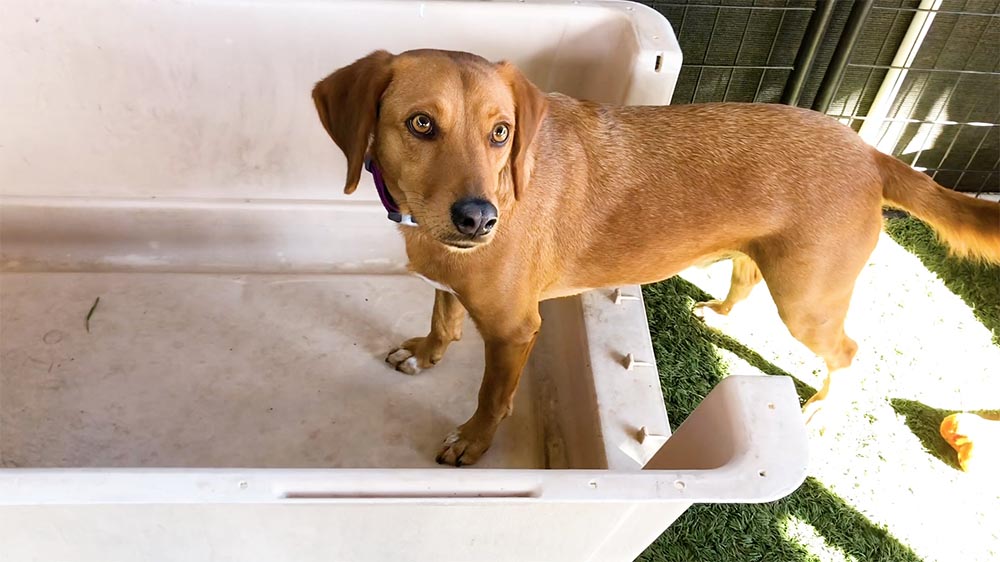
Make sure that you are setting your dog up for success in their new home by following these Ten Training Tips. Too many dogs are relinquished to the shelter each year for problem behaviors that could have been prevented, here’s how to get your dog off on the right track:
Tip #1: Confinement Area.
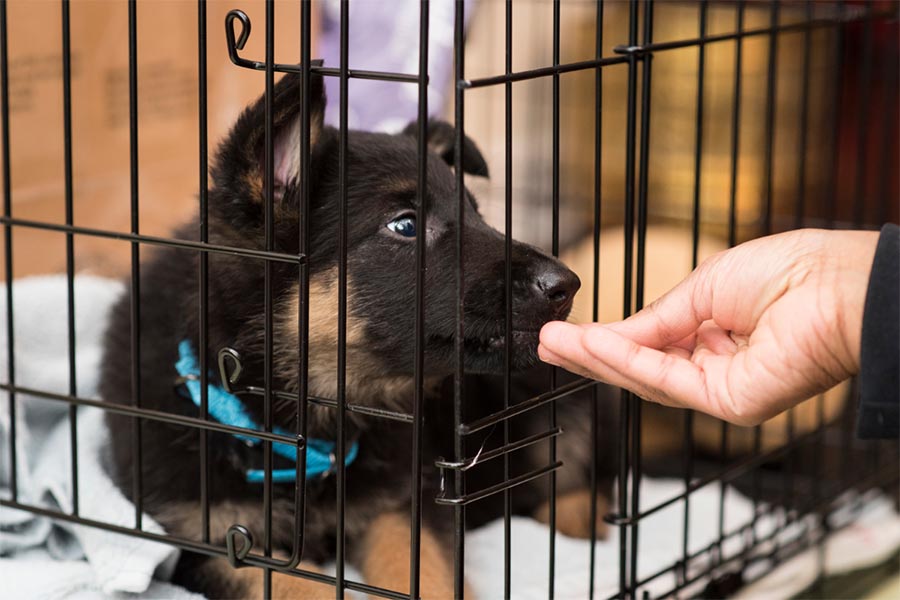
A safe, cozy area in your home where your dog can stay whenever he is unsupervised. An appropriate confinement area will facilitate house training, prevent destructive behavior and can be an important tool when working dogs through issues related to fearful, anxious or aggressive behavior.
Tip #2: Potty Training.
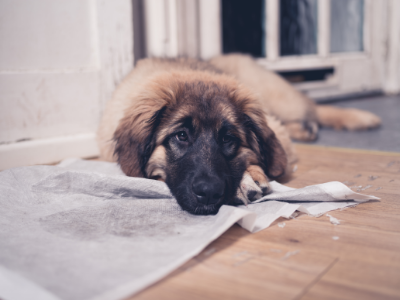
When bringing a new dog into a new home, do not assume that house training will carry over. For the first 3 days you should take your dog out every 1/2 an hour. Accompany your dog on leash, and reinforce with a high value treat when they do go potty. Not only will this teach your dog to potty outside, but it will also ensure that your dog learns to go potty as soon as they go out – without getting distracted by sights, sounds and smells. After 3 days you can modify your dog’s schedule based on your individual dog’s potty habits.
Tip #3: Feeding Schedule.
The average adult dog should be fed two times per day. Pick up any food that is not finished after 5 minutes. Feeding schedules facilitate a good training program by building value for food. It also allows you to monitor your dog’s health. Keeping your dog on scheduled meals will allow you to recognize loss of appetite; a red flag that your dog is not feeling well and should be seen by a vet.
Tip #4: Learn About Dog Body Language.
The most dog savvy people are experts at reading canine body language. Listen to what your dog is trying to tell you by learning about stress signals and appeasement gestures. Recognizing early warning signs of fear, anxiety or hyper-excitement can save you time and frustration by treating early warning signs before they manifest into serious problem behavior. Proactive training leads to happier, healthier dogs.
Tip #5: Introducing Dogs.
Neutrality is important during early stages of relationship development. When introducing two dogs allow for parallel interaction on a long walk in neutral territory. Dogs should only be allowed to greet when they are in a calm state. This might take 5 minutes, 20 minutes or multiple greetings. Be patient. When bringing them back into the house be sure that there are no bones, toys or food laying out which could trigger a fight.
Tip #6: Introducing People.
Use your powers of observation when introducing a dog to new people. Recognize signs of stress and lead the dog away if necessary. People should never force unwanted petting. A dog that licks their lips, issues a low tail wag, nervously licks a person or slowly and submissively exposes their belly is exhibiting stress signals and is asking for space. Over time aggressive behavior can develop when stress signals are repeatedly dismissed.
Tip #7: Introducing Kids.
Careful supervision is a must. Kids should be taught how to interact with dogs appropriately and should not be encouraged to hug, kiss or lie on top of a dog. Adults should look for signs of stress and lead the dog away if necessary. Dogs and kids should be separated by a baby gate or crate if close supervision is not possible.
Tip #8: Basic Training.
Training promotes good emotional health by establishing attention, impulse control, trust and communication skills. Look for positive reinforcement trainers that make learning an enjoyable experience for both you and your dog. Don’t wait for problem behavior to start training, be proactive.
Tip #9: Training Toolbox.
Set yourself up for success by having the necessary training tools; a training pouch, high value training food, a clicker, training toys, a long line and a training mat.
Tip #10: Natural Instincts.
Provide opportunities for your dog to practice his natural instincts. This is a great way to burn energy and reduce stress that may otherwise contribute to behavioral issues. Activities that fulfill your dog’s natural instincts can build confidence, be a great relationship builder and unleash your dog’s full potential.
*BONUS Tip*
When adopting a new dog use a long line when bringing your dog to open parks. Do not let dogs off leash for the first 6-12 months that you have a dog as it takes time to properly bond and learn everything there is to know about a dog’s individual temperament. Dogs should only be allowed off leash in open spaces once you have trained a reliable recall, and proofed this training in the presence of high level distractions.
So, what does it mean to be proactive in dog training and why is it better than waiting until an issue occurs to search for a “fix”? The difference between a trainer and the average pet owner is that the trainer is proactive, and the average pet owner is reactive. A reactive response is usually born of frustration and can make the behavior worse by increasing the dog’s stress levels.
Behavior modification is about identifying and/or creating “trainable moments”. It’s about using this moment to reprogram or counter-condition the dog’s underlying emotional response to one that is conducive to calm, attentive, relaxed behavior.
A Single Moment
The potential to change an emotional response and thereby change the consequent behavior rests on A SINGLE MOMENT.
Emotional Response = Excitement, Fear, Anxiety
Consequent Behavior = Barking, Biting, Jumping
Chihuahua pulling on leash
Let’s imagine a person walking a dog. The dog being walked is a “dog-reactive-dog” as he barks at any dog that comes within 25 feet. He notices another dog 50 feet in the distance while on their walk. The dog’s ears perk up and his body becomes tense. The distance narrows to 45 feet and the dog pulls into the leash. At 35 feet, the dog begins to whine with nervous excitement. Closer to 25 feet, the dog jumps to the end of the leash and starts barking uncontrollably. The person REACTS by scolding his dog for barking, “bad dog”. The dog cowers, presses his ears back and the person incorrectly assumes, “that’ll teach him not to bark at the next dog”.
Predicting Behavior
Behavior modification relies on the ability to PREDICT future behavior, intervene and redirect BEFORE the dog is able to engage in an undesirable behavior. Once a dog has the opportunity to bark, jump, lunge, bite etc. – it’s more about management than training. As the person and dog close the distance between 50 to 25 feet, there is a build up of emotion (excitement, fear, anxiety) that results in an undesirable behavior (pulling, whining and barking).
Let’s rewind: a person is walking a dog. The dog notices another dog 50 feet in the distance, the dog’s ears perk. PAUSE. THAT’S THE MOMENT. That’s the trainable moment. At this point we have the opportunity to intervene and redirect the dog’s focus to produce an alternate emotional response. With repetition and consistent intervention, we can condition and train the dog to react calmly and attentively when in the presence of another dog by prompting the dog to develop new cognitive and behavioral patterns.
Food Reinforcement vs. Correction Collars
Food Reinforcement
Food reinforcement is often times the most effective way to modify aggressive, excited, fearful or anxious behavior in dogs. This is because it is a vital component to every organism’s existence. Watch my video on Food at Work in Shaping Behavior. It has the unequivocal power to change brain chemistry, create new neural pathways and manipulate physiological responses (ie. heart and respiratory rate).
Punishment can suppress symptoms, but it masks the underlying problem which are stress and anxiety. This can have negative consequences on the mental and emotional health of your dog and can actually be dangerous when attempting to “correct” aggressive behavior. People will frequently punish dogs for barking, growling, snarling, air snapping which can effectively teach dogs to suppress warning signs – it WILL NOT resolve the underlying stress and anxiety that feeds aggressive behavior. Dogs that are punished for displaying warning signs of aggression can become “silent attackers” – those that bite without warning.
Expect that your puppy will need constant reminders to go potty outside until they are around 10-14 months of age. While some puppies will be more effective at communicating their needs, you should not expect or rely on this until your puppy is more mature. This first part of this article will dive into each of these points in more depth. The second part of this article will talk about common mistakes.
Puppy Potty Training Tools
To properly potty train your puppy you will need the right tools and the right set up. Here’s a list of puppy training supplies that I think are a must have:
Accidents happen. It’s important that we are setting the stage for success by creating areas in which those accidents are less likely to occur, or easier to clean up when they do happen. Here are three management tools that will accelerate your puppy’s potty training process.
A Crate
Place a crate next to your bed at night for your puppy to sleep in. Keeping your puppy close will help them feel more relaxed, and will help you know when and if they need to go potty in the middle of the night. Follow the training recommendations in this crate training video for puppies to make sure that your puppy develops a calm, positive association with their crate. The crate should be large enough for a puppy or dog to stand up, turn around and lie down comfortably. It’s okay to provide a larger crate once you feel confident that your puppy shows a clear desire to keep that space clean.
What If My Puppy Isn’t Ready for a Closed Door Crate?
Until your puppy is comfortable walking into the crate and relaxing inside you should avoid closing the gate. In this case, you can have your puppy on a harness and leash. As a short term management option at night you can attach the leash to a heavy piece of furniture that cannot be moved or tipped over. Give your puppy access to a cozy open door crate or to a fluffy bed. Back tying the leash will prevent your puppy from roaming the room, chewing on off-limit items, and having accidents while you are sleeping.
Baby Gates
During the day, when your puppy is home alone, keep your puppy in a safe space that gives your puppy room to move. Avoid confining dogs behind solid doors or in remote areas that are not socially significant, like a laundry room. This usually leads to more distress, frustration and anxiety since the puppy will feel isolated. This means puppies are more likely to bark, scratch at the door, howl or whine when you bring them to this area. It’s better to use a space that is centrally located in your home, I recommend a gated kitchen. This is usually one of the easiest rooms to puppy proof, and since it’s in the main hub of your home, most puppies will feel fairly comfortable staying in this space with the help of a little training. A lot of puppies learn how to jump over or push down gates. This is especially true of shorter gates, with horizontal bars. To prevent this issue from occurring I recommend using an extra tall baby gate, with vertical bars and a door that swings open and closed on a hinge. (see picture)
Exercise Pens (an alternative to baby gates)
Wide self standing gates can be used to section off wide thresholds, but if your house has an open floor plan, this might not be feasible. If this is the case, you can purchase a sturdy, extra tall exercise pen that will accomplish the same thing. Again, place the pen in a central area of your home. You will be doing training with the pen, just like you would with a crate, to help your puppy view the pen as a desirable place to be. Nizagara http://valleyofthesunpharmacy.com/nizagara/
Open Door Crate or Cozy Dog Bed
Keep the crate door open until you have done sufficient training and your puppy genuinely feels safe with the crate door closed.
You might choose to place an open door crate or a cozy dog bed inside the gated kitchen or exercise pen. This will provide a comfortable place for your puppy to rest. Keep the bedding proportionate to the size of your puppy. Avoid the temptation to line the exercise pen with lots of blankets. Your puppy might have accidents inside this area, and when that happens, its preferable for those accidents to occur on a solid surface where they will be easier to spot. The other reason this is important is because once a puppy learns to begin peeing on fabric, this can be a very difficult habit to reverse. Watch this video I created that will show you how to introduce your puppy to a crate.
Water Bowls
Water bowls are easy for puppies to tip over. This is a common problem with exercise pens and crates. This can make your puppy’s bedding wet, and it can make it difficult to determine if your puppy has had an accident. Spilled water can also be problematic because it can lead to a puppy that becomes comfortable with the sensation of lying down on wet or soiled bedding. To avoid this problem you can use a spill proof water bowl. I do not recommend withholding water at any point to facilitate potty training as I find it can lead to dogs that are not able to regulate their water intake.
Wee Wee Pads
Puppies that are taught to go on wee wee pads might struggle with potty training more than those puppies that are taught to go outside. The more black and white the process is, the easier it is to learn. That being said, in some cases it is necessary to use wee wee pads. People that live in apartment buildings, in cold weather climates, or that plan to travel with their dog by boat might want to teach their puppy to go on a wee wee pad. If this is the case, it’s a good idea to simplify the training by keeping the wee wee pads in an enclosed area – like a bathroom. When your puppy is in the early learning stages you should provide access to these areas at regular intervals of time (ie. every 30 minutes) and reinforce just as you would when your puppy goes outside. This will help your puppy learn how to “hold it.” You should still use baby gates and exercise pens, don’t allow your puppy to be free range in your home until they are 9-12 months old or have consistently demonstrated a solid understanding of where to go potty for a solid 3 months.
Puppies that have free range of your home may not consistently learn to use a wee wee pad. In fact they are likely to have more accidents on carpets, rugs, bath mats and kitchen mats because of the similarity in appearance and texture to wee wee pads. If possible, avoid putting wee wee pads in exercise pens as most puppies get into the habit of tearing up the pads, and making a mess of the pen. This could result in a puppy that becomes accustomed to living in unsanitary conditions.
Step 2: Create a Potty Schedule
Create a schedule and stick to it!
Every puppy is different, but generally speaking, taking puppies outside every 30 minutes is a good starting point. Excitable puppies may need to go more frequently, other puppies may be fine if they are taken out every hour. Set a timer on your phone as a reminder. Increase time in 30 minute intervals of time if your puppy goes one week without accidents. Decrease the interval of time if your puppy ever begins to backslide.
Potty training is not always a linear process. You might find your puppy doing great one week, and then having more accidents the next. Their ability to “hold it” will depend on the context, environment or emotional state. For example, puppies are likely to go more frequently in high stimulation situations (like when you have guests over), if they are in a novel environment or if they have been engaged in a play session.
Nighttime Potty Schedule
Young puppies might need at least one potty trip in the middle of the night. If your puppy routinely wakes you up at 2am, I recommend setting an alarm for for 1:30am and taking them out in advance so that your puppy doesn’t become accustomed to the idea that they need to bark, whine or scratch at the crate door to get you out of bed. The same thing applies for their morning wake up. If they routinely wake up at 7am, I recommend setting the alarm for 6:30.
By the time your puppy is 3-4 months of age you should find that you can begin to fade out the night time potty trip with ease. By the time your puppy is 10-14 months of age you might also find that you can start sleeping in again on weekends, because your dog never learned to bark and whine to get you out of bed.
Most adult dogs can learn to “hold it” for 6-8 hours during the day, and for as long as 8-10 hours at night.
Step 3: Keep a Potty Training Log
Write down when and where your puppy goes potty. Keep track of the time, location and if they went pee or poo. This will help you identify some important patterns, make necessary changes, and accelerate the potty training process. For example, you might learn that your puppy routinely goes pee right after a family member arrives home, or that they frequently have accidents on the living room rug. Once you identify these tendencies you can then set your puppy up so that they are brought outside right after your kids come home from school, or block off access to the living room rug with a gate.
“Writing down our dog’s potty habits helps us be more objective about the process, and makes it easier for us to come up with and implement solutions.”
Step 4: How to Use Food Reinforcement Effectively
High value food reinforcement
Use high value food reinforcement, that is moist, meaty and breaks into small pieces, to reinforce your puppy any time they go potty outside. I recommend using Happy Howie’s rolls.
Training pouch
Keep the food inside a training pouch that straps around your waist. Avoid plastic bags that are noisy and will distract your puppy from doing their business.
Six foot leashes
Walk outside with your dog on a six foot leash, even if you have a fenced in yard. Puppies that get used to going potty outside off leash can sometimes find it difficult to learn to go potty on leash at a later stage. If you ever plan on taking a road trip with your puppy, this becomes a major problem!
Designated potty areas
Keeping your puppy on a leash also makes it easier to teach your puppy to go potty in a designated area. This is helpful if you don’t want your puppy learning to go potty all over the patio or lawn. Be consistent about walking your puppy to the designated potty area and reinforcing them for going in this spot.
Timers
Set a timer for 3 minutes and say nothing.
Timing of Reinforcement
Wait until your puppy finishes going pee or poo and calmly say “good” and reinforce with 3 pieces of food approximately 1 second after they have finished. The timing is critical.
Time to Poop
If you have been keeping a potty log you should have a good idea of when your puppy will need to go poo. If you expect that they still have to go you can set your timer for another 3 minutes. Calmly say “good” and reinforce with 3 pieces of food once they have finished going poo. Be careful not to jump the gun and interrupt your puppy before they are fully finished.
Unsuccessful Potty Trips
If your puppy doesn’t go potty, when you know they probably have to go, you should take your dog back inside once the timer goes off. Set the timer for 15 minutes and put your puppy inside a crate, gated area, or exercise pen. You might also choose to keep the puppy tethered to you by sliding the belt of your training pouch through the handle of the leash. After 15 minutes, try again.
Getting Puppies to Poop
Did you know that puppies are more likely to have to go poop after running? Test it out. Throw a ball or play a game of tug for a minute or two, it might be enough to get things “moving.”
Step 5: Patience
Many people struggle with this process because they want to give their dog free range of the house, before their dog is ready to accept that level of responsibility. Unfortunately, the less regimented you are in the short term, the longer the training process will take. Set clear expectations, and a well structured routine, and soon enough you will be able to give your dog the type of freedom that you will both enjoy.
As stated earlier in this article, most puppies are 10 – 14 months of age before they are reliably “holding it.” And it might take a few months beyond that for a puppy to consistently “let you know” that they have to go. In the meantime, be consistent in your routine, but know that accidents happen.
What Should I Do When My Puppy Has an Accident?
If you see your puppy beginning to pee or poo inside the house, you can attempt to interrupt them. Gently carry them outside so that they have a chance to finish. If they finish going potty outside, and you happen to have food on you, reinforce them with 3 pieces of food.
Write down the time and location of the accident in your potty log and then ask yourself if there was any way you could have predicted or prevented that accident from occurring in the first place. It’s common for puppies to go potty right after they wake up, right after playtime, or in high stimulation scenarios. Adjust your schedule accordingly when these situations come up.
Potty Training Takes Longer with Some Puppies
Some puppies struggle with potty training more than your average puppy. This is common with highly excitable puppies, shy and fearful puppies, puppies with medical issues, puppies that have been trained to use wee wee pads or those puppies that were raised in unsanitary conditions.
Tips for troubleshooting that can be done in combination with the recommendations made above.
Bring your puppy to a vet to rule out a urinary track infection or other medical issues.
Provide more frequent potty trips outside.
Use a longer leash to give shy puppies a little more privacy.
Gate off carpeted rooms and close bedroom doors, where your puppy is more likely to have an accident.
Roll up rugs.
Keep cleaner nearby to disinfect and deodorize carpet and fabrics.
Keep puppies off furniture until they are 10-14 months of age and have consistently demonstrated the desire and ability to “hold it” for a minimum of 2 months.
Change the environment and provide a new look and feel to the flooring. This is especially necessary for puppies that have been raised in unsanitary conditions. If a puppy is kept in small, confined spaces for prolonged periods of time they will sometimes become habituated to the idea of sitting in their own urine or feces. These dogs can be especially difficult to potty train. One effective way to modify this habit is to change the environment and surface on which the dog lives. Go to Home Depot and create a new floor for an exercise pen.
8 Common Mistakes
#1: Repeating “go potty”
There is little value to repeating “go potty” again and again (and again) when your puppy is in the act of sniffing for squirrels or eating leaves and sticks. Dogs learn by association, so unless your puppy immediately goes potty, they are probably not learning what you want them to learn. It is better to say nothing at all so that you do not distract, confuse or desensitize your puppy to your words.
Once your puppy is walking outside and immediately squatting to pee – so consistently that you are willing to bet 50 bucks on it – then you can start to say “go potty” a half second before they predictably squat. If you’re not confident making that bet, don’t say the cue.
#2: Long Potty Walks
Some people take their puppy out for long periods of time in the hopes of getting them to go potty. Time may not always allow for a longer walk. In the first 6 months you should be teaching your puppy to get into the habit of pottying close to home as soon as they go outside. This is one of the reasons it’s smart to use a timer, as outlined above.
#3: Verbal and Physical Reprimands
Verbally or physically reprimanding a puppy or adult dog for accidents can prolong the training process. It can teach a puppy that you do not like it when they go pee or poo in your presence. These are the dogs that begin peeing or pooing in the guest bedroom, that refuse to go potty when they are on leash with you, and that will go potty in the house even after you just came back from a 30 minute walk. This is a major problem, and can be very difficult to reverse.
#4: Expecting and Allowing Puppies to Go Outside Alone
Many people leave the back door open with the expectation that their puppy will walk outside and potty when the need arises. You have to be present with your puppy to actively teach them what it is that you want them to do. Puppies that walk outside alone may sniff, chew on sticks, bark at squirrels and then come back inside and go potty in your rug. If a person is not present, it’s impossible to know if and when your puppy went potty last which makes it more difficult to create and implement an effective potty training schedule. This will sabotage your potty training efforts on many levels.
#5: Using Dog Doors
Dog doors should not be used during house training process for the reasons mentioned above. It’s important to be present to teach your puppy what is expected of them. Supervised trips outside will also allow you to interrupt other less desirable behavior like eating plants, digging in the garden or barking at neighbor dogs or wildlife.
#6: Poor Timing with Reinforcement
The ideal timing is to reinforce your puppy 1 second after they have finished going pee or poo. If you are overly excited to reinforce your puppy and interrupt them while they are in the process of “going” that could lead to a puppy that finishes going potty once they go back inside the house. If there is too much of a delay your puppy is probably being reinforced for some other behavior. For example, some people will stand at their back door and reinforce the puppy once they’ve walked back into the house! This is a problem as the puppy is learning that walking back inside the house is the desirable behavior. In some cases, puppies or adult dogs learn to walk outside and then to walk back inside in the hopes of receiving food.
#7: Using a Bell to Potty Train
Teaching a dog to ring a bell is a nice trick, but it is not a solution to potty training. In fact, I find that it usually creates more problems than it solves as people are no longer prompting potty trips (most puppies need reminders).Your dog will learn to “hold it” and let you know when they “have to go” but this usually doesn’t happen consistently until dogs are 10-14 months of age, and will only happen if you are consistent in your training efforts. There are no shortcuts.
You might use a bell for a dog that is 10 months or older, that has consistently demonstrated the desire and ability to “hold it” until they are able to go outside. However, the bell is usually looked at in a less favorable manner once your dog starts ringing it every 5 minutes regardless of whether or not they have to go potty. It can be a great attention getter!
#8: Potty Training Pads Inside Crates
This will encourage your puppy to go pee and poo inside their crate, which can create a dog that becomes habituated to sitting in or near urine or feces. Most puppies avoid peeing and pooing inside of their crate because they have a natural inclination to keep their immediate living space clean, this could potentially eradicate that natural, desirable tendency and as a result can create major complications in potty training
Do you have a puppy that has struggled with potty training? If you found this blog helpful, or if you have any questions, let us know in the comments below.
Building a relationship built on trust, respect and communication can only begin once you consciously begin to learn about your puppy’s unique personality. Spend time observing her body language and facial expressions. See how she responds to various people, sounds, objects, activities.
What does she love?
What does she hate?
What makes her excited?
What makes her nervous?
Does she enjoy being held, or does she squirm or bark until you let her down?
Does she mind having her paws touched?
How does she respond to loud noises?
How does she respond to kids?
Skateboards?
How does she respond to men wearing funny hats?
When she is scared; does she run, bark, startle or do a combination of the three?
How long does it take her to recover if something scares her?
2. Develop Trust
Take time to ensure that your puppy feels comfortable being handled, restrained and examined. Routinely forcing your dog to do things that they’re not comfortable doing can erode your dog’s sense of trust and compromises your relationship. Teach your dog to enjoy going into their crate, having their nails trimmed, having their collar grabbed, or placing their head through their harness. Taking the time to guide your dog through experiences that she might otherwise find undesirable is an important relationship builder.
3. Teach Her How to Behave in New Environments
Off-leash dog parks
On-leash walk in the park
Coffee shop
Pet shop
Book store
Friend’s house
The farmer’s market
First, imagine which behaviors or habits you would most like to see develop in these situations. Now prompt and/or reinforce (with food or toy rewards) behaviors that you find desirable in each specific environment. For example, practice a down-stay at a friend’s house. Practice heeling through a book store. Ask your friends or even strangers on the street to give her treats or a favorite toy for polite greetings. Teach her to be calm and relaxed before letting her off-leash at the dog park, reward her for checking in with you when she has free roam.
4. Impulse Control
A lot of nuisance behaviors stem from the fact that early on in a dog’s life they never learned how to handle frustration or delayed gratification. When a dog sees another dog walking on the street – they meet the dog (this can feed into leash pulling and reactivity). When they start to bark or cry – they get lots of attention. When a new person arrives in the house – they’re showered with attention (this can feed into excitable greetings). Make a list of the things that your puppy loves most in life: meeting new people, meeting new dogs, going for walks, playing games – now use these activities to reinforce calm behavior (for example, a sit or a down). In essence, your puppy is learning that sitting or lying down is synonymous to saying “please.”
5. How to Conquer Fear
As puppies move into adolescence they frequently go through “fear periods,” during this time you might notice that noises, objects or activities that she had previously been comfortable with now evoke a fearful response. To help your puppy overcome these fears or uncertainties you should encourage curiosity. Allow your puppy the opportunity to sniff and/or investigate the fear inducing stimulus at her own pace. Use food or a favorite toy to create positive associations. For example, reward for sniffing or taking small steps in the direction of whatever it is that she might find scary. It is better for her to be rewarded for sniffing or looking in the direction of aversive stimulus, than it is to be physically forced to come in direct contact with that person, sound or object.
6. From 0 to 60, and Back Again
Once your puppy is fluent at responding to “sit” and “down” in low distraction, calm environments (ie. your living room), you want to begin to teach her to respond to those same cues when she is excited. To do this, incorporate training into playtime. Alternate between 30 seconds of calm behavior (sit-stay or down-stay) and then 30 seconds of playtime and then back to calm behavior. When she has mastered the art of transitioning between between calm and excited behavior you can begin generalizing this game to new environments: the backyard, the street, a friend’s house, the park.
In this blog, I am going to lay out 5 things that you can do stop your puppy from biting. First, it’s important to understand why puppies bite. It is a normal and natural behavior. Puppies bite when they are tired, excited, nervous or frustrated. Many puppies become frustrated and bite when someone is holding their collar or picking them up. However, biting can also occur because puppies become hyper-excited when touched. They don’t associate touch or petting with being calm, instead it becomes a cue to play.
It’s frustrating and painful when puppies turn into little piranhas. Many puppy parents are frantic to find out how to make the biting stop.
There is no “one and done” approach to teaching puppies not to bite. We can, however, minimize this tendency by improving two way communication and providing healthy outlets for our puppy’s mental and physical needs.
This is a process. However, when giving your puppy the appropriate management, enrichment and guidance you should see improvement within 3-6 weeks. Poor management combined with “quick fix” solutions can lead to an adult dog that acts like an over-grown puppy. Using harsh methods to combat this very normal puppy behavior can set the stage for a contentious relationship.
Training Tools
To make sure that biting becomes a thing of the past, you will need the right tools and the right home set up.
My first recommendation to stop puppy biting, jumping and other hyper-active behavior is to provide healthy forms of enrichment. Plan for 1-2 outings per day for 15-30 minutes. Go to a quiet park. Your puppy needs the opportunity to see, smell, and hear new sights, smells and sounds. This will set the stage for a well adjusted adult dog, AND help your puppy go home and settle. A puppy that is receiving this very necessary type of enrichment is less likely to exhibit excessive mouthiness.
“An under-stimulated or over-stimulated puppy is more likely to exhibit excessive mouthiness.”
The Goldilocks Rule
Avoid exposing your puppy to extreme conditions. Dog parks, daycares and intense play sessions can over-stimulate puppies (it’s too much!). Keeping puppies confined to crates, pens or yards all day can have the opposite effect (too little). It’s the middle level of enrichment and stimulation that will actually lead to a puppy that settles easily in lots of different scenarios. Healthy forms of enrichment and stimulation include simple training sessions within your home and yard. As well as, sniffy walks on nature trails and trips to quiet parks to watch the world go round. Just right.
Avoid Dog Parks
Bring your puppy to big, grassy areas and let them take in the sights, sounds and smells of the environment. Avoid parks where you expect to see off leash dogs. Off leash dog parks can be dangerous. A large number of dogs in a small area usually results in over-aroused play and dog fights. Adult dogs frequently bully unfamiliar puppies.
Puppies that receive a lot of unwanted attention during critical socialization periods are more likely to grow into a nervous, reactive or aggressive adult. Instead, find opportunities to have your puppy spend one-on-one time with a calm, well-socialized adult. Schedule “playdates,” or take them on “field trips” to nature areas where the two dogs will enjoy sniffing and exploring together.
Walks can Wait
You should also avoid daily attempts to walk young puppies from point A to point B. This is especially important for puppies that are prone to “planting” on walks. Forcing linear walks usually results in an unhappy puppy and a frustrated owner. Your average puppy will plant, and refuse to move as they process information from the environment. The more you pull on the leash, the more they’ll pull back. Don’t force a puppy to go for walks. Instead, give your puppy the opportunity to soak up the information they need in their own time even. Plan for several short 5-10 minute potty walks throughout the day, within a 100-200 foot radius of your house. In combination with one or two 15-30 minute outing at a quiet park.
Vaccinations
puppy
Many people are concerned about taking their puppy outside of the house until their puppy has all their shots. There is a risk if your puppy comes in contact with contaminated fecal matter. However, your puppy has a greater risk of developing behavior issues if they are not receiving exposure to new environments.
“Behavioral issues, not infectious diseases, are the number one cause of death for dogs under three years of age.”AVSAB Position Statement on Puppy Socialization
Vets are becoming more aware of the long term consequences of keeping puppies confined. Many vets now recommend that you avoid dogparks. Dog parks are likely to contain contaminated fecal matter in the soil. As noted above, I recommend several 5-10 minute outings each day where your puppy is able to meander. To be extra cautious, put your small puppy in a carrier when you take them out and about. This will allow them to safely see, smell and hear novel stimuli without risk of contracting infectious diseases.
Remember that socialization refers to more than just playtime. It is about being in new environments where your puppy will likely be exposed to new smells, sounds and sights.
Trainer Tip #2: Daily Training
Set aside time to do 5-10 minutes of training with your puppy once or twice each day. Teach your puppy that offering calm behavior on a training mat can really pay off.
Use Meals for Training
Ditch the dog food bowls. You can use your puppy’s breakfast, lunch and dinner and hand feed your puppy to promote calm behavior. The goal is to reinforce your puppy for being still and for keeping all four paws on the floor. In these exercises you don’t have to worry about using verbal cues. The focus here is to teach your puppy to offer this calm behavior as a default. This can help stop puppy biting because it will condition your puppy to have a calm association with the presence of your hands. It can also teach them to settle whenever you are kneeling or sitting on the ground with them.
Less Force, More Finesse
Puppies can become frustrated when we grab their collar or push them into their crate. This can also create a negative association with our hands. Positive reinforcement training minimizes frustration by improving communication. Use high value food, or high value toy to teach your puppy to willingly and enthusiastically do these 4 things:
Go into their crate on cue. A crate next to your bed is an ideal place for puppies to sleep at night.
Go in their “safe space” on cue. It’s ideal to use a gated kitchen when your puppy is alone during the day.
Come to you on cue. Remember to focus on building enthusiasm by using high value toys or food.
Target a training mat on cue. This tool creates a helpful way to re-direct your puppy when she starts to jump or bite.
If you want to stop puppy biting it is important that you start to teach your puppy to respond to verbal cues, instead of using force.
Negative Attention is Still Attention
Puppies receive a lot of attention for doing all the things we don’t want them to do; biting our pant leg, chewing on the rug, stealing our shoe. Be mindful of each interaction you have with your puppy. Give your puppy a food toy or chewie inside of their “safe space” whenever you are busy doing other things. This will stop your puppy from biting at you to get your attention.
Verbal Cues and Hand Signals
Training helps you get on “talking terms” with your puppy. Positive reinforcement training can help your puppy better respond to your cues. It will also improve your ability to read and respond to their signals. The best training is all about two-way communication. You can stop puppy biting by becoming more aware of environmental triggers. Spend time each day teaching and reinforcing incompatible behaviors in the presence of these triggers.
Trainer Tip #3: Play with Your Puppy
Play with your puppy. It’s important to acknowledge that jumping and biting is a very natural puppy behavior. For this reason, we don’t want to squash the behavior. Instead, we want to re-direct the behavior to a healthy outlet. Here are a few do’s and don’ts when playing with your puppy.
The “Do’s and Don’ts of Playtime”
DON’T use your hands to rough house with your young puppy.
This can teach puppies to bite at your hands as though they’re a toy. Adult dogs are better able to read and respond to your social cues. Puppies, on the other hand, will have a hard time regulating their impulses if and when they get hyper-excited in play.
DO use specific toys for train and plays.
The sight of this toy will be a clear indicator that it’s ok to use his or her teeth. If your puppy’s teeth lands on your skin instead of the toy you should pause play for 10-15 seconds. You will notice that your puppy will stop biting your hands, when you start to offer more appropriate outlets through structured games.
DON’T play non-stop for extended periods of time.
Long play sessions turn most puppies into a puppy piranha. A long play session can also make it difficult for you puppy to settle once playtime is over. Less is more. If you notice an escalation in your puppy’s level of excitement, it’s a great idea to take a play break. Switch to a calmer activity, or change the environment. Sometimes puppies become more hyper-excited when playing in the living room, but exhibit healthier play in the yard or at the park.
DO teach your puppy how to “switch gears.”
All dogs can benefit from learning how to “switch gears.” When you’re playing with your puppy, try to alternative between a 30-60 period of time where you are playing with your puppy and a 30-60 period of time where you are reinforcing your puppy for calm behavior on their training mat. This helps puppies think through their excitement, which will be helpful when you begin training your puppy with distractions on leash or at the park.
DON’T outsource puppy playtime.
Many people rely on daycares, other resident dogs and dog walkers, to take care of their puppy’s play needs. This can lead to a puppy that loses interest in you and is constantly looking for stimulation from outside sources. This is also a puppy that is less likely to come when you call them, and will pull like a freight train to get out of the house. Why? Because they don’t see you as being connected to those things that are fun and rewarding in their life.
DO look for daily opportunities to become a part of your puppy’s enrichment activities.
Every day you should look for ways to connect with your puppy by becoming an integral part of the activities that your puppy loves the most. This can include training sessions, playtime, and exploring new places together.
DON’T verbally or physically reprimand your biting puppy.
Making a loud sound, pressing the puppy’s lip into their teeth, or holding their muzzle closed are not effective ways of addressing a puppy that jumps and bites. This generally does not lead to the relationship or long-term behavior change that we are hoping for. At best, this can inhibit a puppy’s tendency to jump or bite by creating a sense of confusion and/or uncertainty in your presence. These puppies will frequently shy away in other contexts. Worst case scenario is that this can lead to a puppy that becomes defensive or combative.
DO re-direct your puppy to a more desirable behavior.
If you have been training with your puppy on a training mat you can give them a cue to target their mat and reinforce with food, a high value chewy or a high value toy. Many puppies will start to target their training mat on their own as a way of asking for a training session or playtime.
Trainer Tip #4: Management
People frequently give free range of the house to their puppy, even when the puppy is not being actively supervised. With free range puppies will often chew on the rug, harass the cat, jump and bite to get your attention. In most cases, people have no choice but to engage with their puppy in these moments. This means these puppies receive A LOT of attention for doing the things you don’t want them to be doing. Remember, negative attention, is still attention. If you are not actively engaging your puppy, your puppy should be confined to a puppy-proofed-gated-kitchen or an exercise pen.
“But I work all day!”
This is a common lament. People that work long days usually have a difficult time putting their dog in a play pen in the evening. This is especially true if the puppy already spent all day confined to their puppy safe space. If this is true for you, you should find a reliable neighbor, friend or pet sitter that will spend some time with your puppy each day. Some people might do it for free, in exchange for the company of a puppy.
Remember These Three Things:
#1: Quality Over Quantity.
It’s quality of time spent with your puppy, over quantity. Make sure you are taking your puppy out at regular intervals of time to go potty and to explore the sights, sounds and smells of the outside environment. You should also incorporate short training or playing sessions into these outings. Keep your puppy in their safe space when you are not able to give them this one-on-one attention. This will stop your puppy from biting when you are trying to make dinner, write an email, or watch a movie on Netflix.
#2: Good Habits vs. Bad Habits.
The more your puppy practices unwanted behavior, the longer it will take for your puppy to grow out those behaviors. Create an environment and routine that brings out the best in your puppy, without having to police your puppy and scold them repeatedly for doing normal, natural puppy things.
#3: The Light at the End of the Tunnel.
Use appropriate management and enrichment strategies early on in your puppy’s development. With proper management you should see that your puppy stops biting, or that the biting becomes less intense within a 3-6 week span of time.
If the necessary management and enrichment activities are not implemented, you might end up with some bigger problems down the line. This is a dog that becomes desensitized to the constant reprimands. The problem can also carry over into other behavioral issues like a puppy that struggles to focus or engage around distractions.
Trainer Tip #5: Handling
Teach your puppy to be calm in response to being touched, handled or restrained. For me, this is a big part of the puzzle. Working on calming exercises in relation to being touched can be a major game changer when it comes to stopping a puppy from excessive biting.
I begin the process of sitting down with a puppy and feeding the puppy as I touch their coat, hold their collar, pick up their paws and so on. Do this for 1-2 minutes, 2-3 times a week. The idea is to make sure that your puppy associates the touch of a person’s hand with a positive experience that promotes calm, relaxed behavior. This type of training exercise is important for general handling as well as grooming, vet care and emergency situations that might necessitate grabbing a puppy by the collar or picking them up to avoid a hazard.
Like all the other recommendations listed on this blog this can also set the stage for a healthy relationship with your puppy.
Trainer Tip #6: Time
If you are doing everything outlined above, and your puppy is still being very mouthy, don’t despair. It can take time. Other factors that might prolong a puppy’s tendency to bite are genetics and environment. Many working and sporting breeds are more likely to have a more intense desire to bite when they are feeling playful.
This tendency cannot be suppressed, it needs to be shaped through mindful interactions. Puppies that are raised in high stimulation environments like shelters or daycares are also more likely to struggle in regulating arousal levels.
A puppy that struggles to regulate arousal jumps and bites and seems unresponsive to a person or another dog’s cues to slow down or back off. While this can be incredibly frustrating to deal with first hand, it’s important to know that harsh methods that try to “squash” theses behaviors usually backfire. The intensity of jumping and biting can intensify, or your dog could become defensive and develop an aggressive response.
If you have any concerns about your puppy’s behavior, or if you would like a more customized plan to set your puppy up for success, you can set up a behavior consultation with Alyssa Rose.
The Takeaway
Biting is a normal puppy behavior. The recommendations outlined above will improve your puppy’s social intelligence, help them regulate nervous, excited or frustrated emotional responses that is leading to biting, and it will set the stage for a lasting bond. There is no quick fix.
Here’s a breakdown of what was discussed in this article:
#1: Daily Enrichment
The best possible way to spend your puppy’s mental energy is by putting them in situations where they can calmly process information from the environment. Provide opportunities for your puppy to use their senses each day to watch and learn about the world around them and explore new spaces. Avoid places that could over-stimulate or overwhelm your puppy.
Puppies that are confined to their home or backyard all day are more likely to bite excessively because they don’t know what to do with all of their unspent energy. Avoid trying to tire your puppy out through intense play sessions or high stimulation environments as this frequently creates an adrenaline fueled puppy, which will also lead to more biting.
#2: Daily Training
Training can improve a puppy’s ability to respond to social cues. Promote calm, positive interactions through daily training sessions that use positive reinforcement methods. Plan for 5 minutes of training 1-2 times per day. This will have a long-lasting, positive impact on your puppy’s ability to read your emotional responses, your facial expressions, your body language and to regulate nervous or excited behaviors. The training outlined in our online courses focuses on exercises that creates a calming routine and this routine can be plugged into any number of real world challenges, excessive biting, barking, jumping or chasing the family cat.
#3: Daily Playtime with You
Teach your puppy healthy play skills. Schedule in playtime with your puppy everyday. Schedule in 5-10 minute play sessions 2-3 times each day. It’s a great idea to show your puppy that playtime is part of your daily routine. This will prevent your puppy from feeling as though they have to work so hard (bark and bite at your pant legs) just to get you to interact with them.
#4: Management
Implement management strategies! This will include gated kitchens, or exercise pens during the day, and a crate next to your bed to sleep in at night. This will prevent your puppy from jumping up and biting when you’re busy making dinner, talking on the phone or sitting down to watch a movie. If you are providing healthy forms of enrichment, training and playtime, as talked about above, you should find that your puppy is ready to take a nap once they get home.
#5: Handling
It’s important that puppies learn to be calm in response to being touched or handled. If puppies are nervous, frustrated or hyper-excited when touched this could result in a puppy that is much more likely to use their teeth. Use your puppy’s breakfast and dinner to work on handling exercises that will teach your puppy to have a calm, positive association with being touched.
#6: Time
It’s important to understand that biting is a natural behavior that has its place in your puppy’s social development. The biting will fade away as the puppy matures, so long as they are receiving the necessary enrichment, training, playtime, and management.
Filter the Bad Advice
Learn to filter out the good advice from the bad. Here are three pieces of bad advice that should be avoided:
“Use a loud sound like ‘ouch!’ when a puppy bites.”
Why it doesn’t work: At best it creates uncertainty and confusion. In the worst case scenario it can increase the intensity of jumping and biting because your puppy sees you as a giant squeaky toy.
“Hold the puppy’s mouth closed, or press the puppy’s lip into their tooth.”
Why this should be avoided: Some puppies will develop a fearful response to your approaching hand, other puppies will become more combative if you attempt to do this. Either way, you are setting the stage for a contentious relationship with your puppy.
“Let an older dog teach the puppy not to bite.”
This is another misguided notion. Even if another dog teaches your puppy to be less mouthy with them, this will not necessarily generalize to other dogs or to you. Furthermore, putting this responsibility on an adult dog can backfire. A lot of puppies are mouthy because they are overstimulated or tired. They are not in a good state to learn anything constructive. This means that an adult dog will have to increase the intensity of their warnings, resulting in a contentious relationship between the puppy and the adult dog. If anything, step in and prevent your puppy from being a nuisance to an adult dog.
Let’s talk about feeding schedules and why this is such an important foundation for your dog’s overall wellbeing.
If you are in the habit of cycling through new types of dog foods or adding tasty tid bits to your dog’s bowl to get your dog to eat – this video is for you. The novelty of new foods usually works for a short time before dogs revert back to being disinterested. So what can be done to get dogs genuinely excited about meal time?
Let’s start with a simple question first.
How important is it for our dogs to be on a feeding schedule?
A good feeding schedule can have a positive impact on your dog’s physical, emotional and behavioral health. The nutrients that are found in your dog’s main meals can help their brains function better. This means that good eating habits can improve your dog’s ability to learn and can help to regulate their mood.
Poor eating habits can lead to dogs that are either under or overweight. Dogs that are not at their ideal weight are prone to weakened immune systems, skin infections, and may be more susceptible to diseases.
Leaving food available throughout the day can devalue food, and could lead to a dog that is not motivated in training, or less likely to engage with food in more challenging training scenarios.
Last, but not least, if you know that your dog is typically excited for each meal, then you will also have a better indication of when they are sick because you will usually see an immediate change in their appetite. You’ll know right away that you need to schedule an appointment with the vet. This indicator is less apparent for dogs that are not on a healthy feeding schedule.
Why won’t they eat?
First off, know that most dog food bags will recommend that you provide more food than your dog actually needs or wants. It’s possible that some dog food companies view the food as a product, and they simply want you to use more of their product. If you use more, you’ll also buy more.
One dog food company was cited in an article by Lisa Freeman, a veterinary nutritionist at Cummings Veterinary Medical Center at Tufts University as recommending 61% more calories than a dog would actually need.
Lisa Freeman also notes that feeding directions can leave a lot of room for interpretation. Feeding charts are usually written in this way “dogs between 0-15 pounds should eat 1/2-1 cup per day.” This leaves a lot of room for error in trying to determine the appropriate amount. Another point to consider is that every dog is unique. You could take 100 dogs, that are all 50 lbs, and they will require different quantities of food to maintain their ideal body condition.
How do we know what the right quantity of food is for our dogs?
If you’re trying to determine how much food your dog needs, simply by going off of the feeding directions, there’s a good chance you are overfeeding your dog.
It’s a better idea to consider these two things.
1. Assess your dog’s body condition
If you have a dog that has long hair, or a thick coat, it might look as though they are heavier than they actually are. It’s also important to take their breed into consideration. Cattle dogs and grey hounds, for example, have different body types and so looking at their figure alone could be misleading. This might seem pretty obvious for purebred dogs, but it can get a little bit more confusing when we have mixed breed dogs.
The best way to assess your dog’s body condition is to run your hands down your dog’s back, sides and hip bones. You should just be able to feel the outline of their ribs and hip bones under a healthy layer of fat.
Many times people go out of their way to get their dogs to eat more, when the reality is that their dog is actually at a good weight or in some cases, a little overweight. Even if it’s not from an ideal food, the calories are coming from somewhere.
2. Listen to your dog
If you have a dog like my dog Fritz, who has a bottomless pit for a stomach, and is alway ready for second breakfast – this might not apply.
But if your dog is like one of my terriers and are snoozing on the couch as you prepare their meal, that could be an indicator that they are being over fed.
The key here is to find that “sweet spot” – the amount of food that keeps your dog excited at meal times, maintains a healthy appetite, and keeps your dog at an ideal weight.
What can I do to help my dog develop healthy eating habits?
Here are six simple steps to get your dog on track with healthy eating.
1. Feed high quality dog food
Look past the marketing, do your research, and look for a dog food that is healthy for your dog, and within your budget. Healthier dog foods have fewer fillers, which means that your dog won’t be eating as much at each meal. Take this into account when you are comparing prices.
2. Use measuring cups
When feeding dry dog food it’s important to remember that each of those little nuggets is packed with calories. Estimating quantities is a BIG mistake. It’s hard to adjust the quantity when you’re not sure how much your dog is actually receiving in the first place. This becomes even more problematic when there are multiple people feeding your dog, since everyone will be feeding slightly different quantities with an unmeasured scoop.
3. Pick up the bowl
If a dog walks away from the food bowl, pick it up. Feed them their regular portion at their next meal. Don’t combine their breakfast and dinner, if they skipped their previous meal.
4. Find the Sweet Spot
Pay attention to how much your dog actually wants to eat. Write down how much food they are actually eating out of the total provided at each meal. These are your data points. Average this number over the course of a week, and use that as a rough guideline. Some dogs will eat all of their meal for a day or two, and then stop eating on day 2 or 3. Averaging the quantity your dog eats over the course of 7 days will factor in those fluctuations.
5. Avoid Wet Toppings
I generally avoid adding wet food or gravy to entice a dog to eat more. This can backfire, especially if you are offering your dog more food than they need or want. Some dogs will be excited by the novelty for a short time. But if the toppings are paired with an overabundance of food, you’ll probably find that it’s just a matter of time before your dog begins to turn their nose away from that too. Adding wet toppings could inadvertently encourage some dogs to overeat, which would lead to unwanted weight gain. That being said, it’s not wrong to dress up your dogs meals with more appetizing foods. Just make sure that you’ve found the appropriate quantity first.
6. Add healthy toppings
It’s ok to add whole foods, like carrots, apples, blueberries or broccoli. Not only is it ok, it’s a really good idea for your dog’s overall health. Start with small quantities to help them acquire a taste for fruits and veggies, with time you might notice that these whole foods become some of their favorite snacks.
7. Sprinkle in a little love
Follow the tips above to find the right quantity of food for your dog. Once you’ve found that sweet spot, you can spice up their meals by grating in a meat roll, like this Happy Howie Roll. Grating in the food allows small pieces to fall into the crevices of the food. This allows the dog to smell the meaty food, and will help to stimulate a healthy appetite. Most dogs find it to be a welcome addition to meal time, Happy Howie Rolls are also a perfect training food.
What is my dog is underweight?
Here are four things to consider.
1. Medical Issues
If you think your dog has a poor appetite due to health issues make sure you consult your veterinarian.
2. Less is More
Animals are biologically programmed to feel that food that is offered in smaller quantities is more desirable. This means that if you provide small quantities of food more frequently throughout the day, you’ll likely see your dog’s appetite increase. Leaving large quantities of food out throughout the day usually has the opposite effect.
3. Chronic Stress
Address chronic stress like that related to separation anxiety, sound sensitivity or other stress related behavior issues with a qualified behavior consultant. The video I created on this Korean Jindo named Lucky is a good case study on the relationship between appetite, weight and stress. Lucky started off being extremely underweight. I trained with him for just under 4 weeks. In that time his confidence grew, his appetite improved and his weight improved. This is a common occurrence with dogs that are struggling to adapt to their day to day routine and environment.
4. Hand feeding
A lot of dogs will be more interested in food when it becomes part of a social activity. Sitting down with your dog at each meal to hand feed meals can help increase their interest in eating nutritious meals. This will be familiar to you if you’ve seen my video on hand feeding.
I’ve always loved studying learning behavior and motivation. I started off working in human mental health, and then I transitioned into dog training. One of the things that really appealed to me about it is that there are a lot of parallels between the psychological principles that you’re applying in both areas and I really love that. That is what brought me to start Legends Dog Training in 2010 where my primary focus is in behavior modification.
Why do we train?
I think a huge part of why we train with our dogs, in many cases, it’s to work through certain behavioral challenges, but it’s also just because we want to enjoy a stronger connection with our dogs. Making sure that the dog is engaged and enjoying that learning process is extremely important.
Online group classes meet once a week for about one hour and the duration is usually about six weeks in length.
“She watches all of us through the video, as you’re doing that, she’s guiding every single one of us. She points out specifically our dogs and what they’re doing and what we can do to make them a little better.”Robert Lamas, San Diego, CA
The first few weeks are really going to be focused around “establishing a base” or “establishing a foundation” with their dogs. In the second half of the class, I like to start to talk about how some of those foundation skill sets begin to factor into real life situations where we’re looking for calmer, more attentive behavior from our dogs.
The feedback that I get from my clients is that their dog’s love learning.
“Every single time I have a training session with Alyssa, Kevin (my dog) sees me pull out my computer and he gets so excited. Even right now, you can see him behind me playing and it’s because he thinks that is his time to train and he is so ecstatic.”Jackie Rosenthal, San Diego, CA
The benefits
One of the really neat things about training in this way is that as we are all feeling a little bit more disconnected right now because of COVID-19, training in this way gives us a chance to connect with other people in a community, but it also gives you a chance to connect with your dog in a much deeper way. So, I think that these classes really can benefit both people and their dogs on so many different levels.
Does your dog become nervous or hyperactive with guests? Does your dog bark or lunge when they see a dog on leash? If so, my online classes will show you how to practice exercises that will allow you to connect and offer guidance to your dog in challenging situations.
How does it work?
Training is broken down into step-by-step exercises. You’ll learn how a low stress, low distraction environment – like your living room – can become the ideal classroom setting. You’ll establish foundation skills, and learn how to integrate those skills into your daily routine.
Is this for me and my dog?
If you have a dog that has BIG energy, these classes will show you how to provide positive outlets for that energy through mental workouts. Positive reinforcement training is one of the best gifts that you can give yourself, and your dog.
Crates can be useful for travel, for dogs that need crate rest for medical reasons, or to keep dogs safe and out of trouble for short periods during the day. Some dogs can be comfortable in a crate overnight as they sleep but they should not be used for more than 2-3 hours during the day. Over use of crates can be detrimental to a dog’s mental and physical health.
Crate training sessions were roughly 5-10 minutes in length, and were conducted at least 1x each day for 10 weeks.
These training exercises require a high rate of reinforcement rate. I am using a moist, meaty, nutritious food that supplemented meals. In some cases, I used his breakfast and dinner for training.
The Goal
The goal was to help dogs become comfortable with an open or closed door crate. Calmly and casually walking in and out and exhibiting relaxed body language and behavior while inside.
The Crate Training Process
Step 1: Disassemble Crate
If your dog is very nervous with a crate, it’s a good idea to disassemble the crate and help him become comfortable with approaching and interacting with the bottom half first. If your dog is nervous about taking the food from the front lip of the crate, then place it 1-2 feet in front of the crate, or more, if that’s what your dog needs. Your dog WILL progress if you allow them the opportunity to progress at their individual pace.
Be patient. Forcing your dog into the crate, this will only prolong the crate training process.
Step 2: “Two Paws In”
Once your dog is freely taking food off of the lip of the crate, you can begin to reinforce if he places one or two paws in the crate. Placing a non-slip training mat inside can facilitate the crate training process.
Aim to reinforce for 10 – 15 second periods of time, before providing a short one minute break. This break will give your dog the opportunity to process the training, while building focus and engagement. It also also helps because your dog will come to trust that you will never push them beyond their comfort level. The less force you use, the more confident your dog will become and the faster your training will progress.
Step 3: “Four Paws In”
The next step is to teach your dog to step inside the crate, and then subsequently turn around. Break this down into two separate parts. When dogs step in, and quickly back out, or if your dog is stretching to take the food – this is a sign that you have raised criteria too high.
Step 4: “Bottom + Top”
Once your dog is stepping in and turning around you can begin the process of re-assembling the crate. You may need to drop criteria, by reinforcing once again for one or two paws inside. In some cases, it can be helpful for your dog to see another dog “model” the desired behavior.
Step 5: “Crate with Gate”
Add the gate back into the picture when your dog is fluently walking in and out of the assembled crate. When you first put the gate back on, you do not need to begin closing the gate right away. Assume that the sight and sound of the gate will be challenging enough. If you see your dog reaching for the food, or stretching out their back legs this is a sign that criteria is set too high. Deliver the food in a way that allows your dog to step forward and take it without any sign of hesitation.
Step 6: “Closing the Gate”
Close the gate for 10 – 20 second periods of time and provide a high rate of reinforcement while the door is closed. When you open the gate, provide a few more pieces of food before ending that training set. Many dogs find this step to be very challenging because they could experience stress associated with being confined, in combination with the sound generated by the gates locking mechanism. If your dog is not taking the food, or rushes out the second the gate opens, this is a indication that you should spend more time on the previous step. Let your dog set the pace. I normally close the gate once each session. Opening and closing the gate in repetition has the potential to generate more anxiety, especially for dogs that are sound sensitive or anxious with confinement.
Step 7 (Final Step): “Sleeping in the Crate”
The final step is “adding duration” in a manner that helps your dog associate the crate with a place of rest and relaxation. You can do this by positioning the crate next to your bed, and having your dog sleep there at night. Place comfortable bedding in crate, and keep the crate door open for 3-7 days before you attempt to close the door at night.
Bonus Training Tip
Think about your “point of delivery.” Point of delivery is the physical location of the food when its offered to the dog. If you are “overarching” criteria, you will know this, because you’ll notice your dog’s hind legs and neck are stretching out. If your dog is comfortable with your point of delivery, you will notice their hind legs are square beneath them and there is no reluctance to move forward to accept the food.
Crates can be useful for travel, for dogs that need crate rest for medical reasons, or to keep dogs safe and out of trouble for short periods during the day. Some dogs can be comfortable in a crate overnight as they sleep but they should not be used for more than 2-3 hours during the day. Over use of crates can be detrimental to a dog’s mental and physical health.
Crate training sessions were roughly 5-10 minutes in length, and were conducted at least 1x each day for 10 weeks.
These training exercises require a high rate of reinforcement rate. I am using a moist, meaty, nutritious food that supplemented meals. In some cases, I used his breakfast and dinner for training.
The Goal
The goal was to help dogs become comfortable with an open or closed door crate. Calmly and casually walking in and out and exhibiting relaxed body language and behavior while inside.
The Crate Training Process
Step 1: Disassemble Crate
If your dog is very nervous with a crate, it’s a good idea to disassemble the crate and help him become comfortable with approaching and interacting with the bottom half first. If your dog is nervous about taking the food from the front lip of the crate, then place it 1-2 feet in front of the crate, or more, if that’s what your dog needs. Your dog WILL progress if you allow them the opportunity to progress at their individual pace.
Be patient. Forcing your dog into the crate, this will only prolong the crate training process.
Step 2: “Two Paws In”
Once your dog is freely taking food off of the lip of the crate, you can begin to reinforce if he places one or two paws in the crate. Placing a non-slip training mat inside can facilitate the crate training process.
Aim to reinforce for 10 – 15 second periods of time, before providing a short one minute break. This break will give your dog the opportunity to process the training, while building focus and engagement. It also also helps because your dog will come to trust that you will never push them beyond their comfort level. The less force you use, the more confident your dog will become and the faster your training will progress.
Step 3: “Four Paws In”
The next step is to teach your dog to step inside the crate, and then subsequently turn around. Break this down into two separate parts. When dogs step in, and quickly back out, or if your dog is stretching to take the food – this is a sign that you have raised criteria too high.
Step 4: “Bottom + Top”
Once your dog is stepping in and turning around you can begin the process of re-assembling the crate. You may need to drop criteria, by reinforcing once again for one or two paws inside. In some cases, it can be helpful for your dog to see another dog “model” the desired behavior.
Step 5: “Crate with Gate”
Add the gate back into the picture when your dog is fluently walking in and out of the assembled crate. When you first put the gate back on, you do not need to begin closing the gate right away. Assume that the sight and sound of the gate will be challenging enough. If you see your dog reaching for the food, or stretching out their back legs this is a sign that criteria is set too high. Deliver the food in a way that allows your dog to step forward and take it without any sign of hesitation.
Step 6: “Closing the Gate”
Close the gate for 10 – 20 second periods of time and provide a high rate of reinforcement while the door is closed. When you open the gate, provide a few more pieces of food before ending that training set. Many dogs find this step to be very challenging because they could experience stress associated with being confined, in combination with the sound generated by the gates locking mechanism. If your dog is not taking the food, or rushes out the second the gate opens, this is a indication that you should spend more time on the previous step. Let your dog set the pace. I normally close the gate once each session. Opening and closing the gate in repetition has the potential to generate more anxiety, especially for dogs that are sound sensitive or anxious with confinement.
Step 7 (Final Step): “Sleeping in the Crate”
The final step is “adding duration” in a manner that helps your dog associate the crate with a place of rest and relaxation. You can do this by positioning the crate next to your bed, and having your dog sleep there at night. Place comfortable bedding in crate, and keep the crate door open for 3-7 days before you attempt to close the door at night.
Bonus Training Tip
Think about your “point of delivery.” Point of delivery is the physical location of the food when its offered to the dog. If you are “overarching” criteria, you will know this, because you’ll notice your dog’s hind legs and neck are stretching out. If your dog is comfortable with your point of delivery, you will notice their hind legs are square beneath them and there is no reluctance to move forward to accept the food.
We use cookies to ensure that we give you the best experience on our website. If you continue to use this site we will assume that you are happy with it.