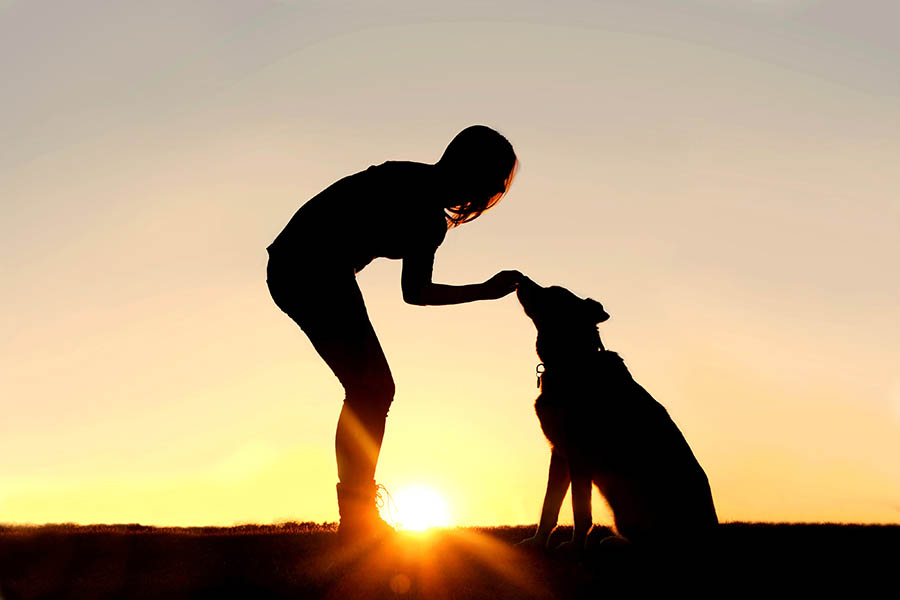
Keep it simple. English is a foreign language to your dog. Here are a five rules to help bridge the communication gap.
Rule #1: Over Use of Verbal Cues
We try to use verbal cues a lot when our dogs are in emotionally charged situations (like when they are barking, jumping). This is not effective because your dog might be too worked up to think and connect with you effectively in that scenario. The short-term solution is to use body language or create more space in order to promote calmer behavior. For example, stepping in between your dog and a trigger, kneeling down and getting on their level can be helpful in calming a dog down. The long-term solution is to engage your dog in training that helps to condition calm responses. Use positive reinforcement methods and create conditions that act like stepping stones to your final goal.
nother common mistake with verbal cues is that we will use one word to mean two different behaviors. Don’t confuse your dog by using one word to mean two different behaviors. If “down” means put your belly to the ground, you should use another word, like “off,” to mean jump off the couch. If you say “down” when your dog is on the couch, you are basically telling him to “get comfortable.” If you want your dog to sit, say “sit.” It’s confusing for a dog to hear the words “sit-down” – which taken literally should mean sit first, then proceed to down position.
Rule #2: Focus on Body Language and Movement
Using verbal cues when your dog is under a high level of stress or arousal will long-term diminish the significance of your verbal cues. For example, if your dog begins barking at the neighbor’s dog it is more effective to “body block” and lead him in the opposite direction, than it is to shout “quiet” or “no bark.” If anything, your dog is likely to interpret loud, repetitive commands as you joining in with the barking.
Rule #3: Bonding with Your Dog
Make sure that you find activities that you and your dog can do together that you both enjoy. This could be positive reinforcement training, playing tug or fetch or taking a hike. Schedule this time in with your dog just like you would schedule a phone call or work meeting. It’s that important.
Rule #4: Generalize cues
If dad trained the dog to sit, lie down, stay, come, leave-it, high five, spin in a circle and play dead on the carpet in the family room, that’s a great start. Now the dogs needs help learning how to generalize all of these behaviors to:
Other family members
Different surfaces
Other environments
A large variety of distractions
Rule #5: It’s a two way street
We spend a lot of time trying to teach our dogs to listen to our every command, but we fail to take the time to listen to their attempts to communicate with us. Become an expert in your dog’s body language. Respect your dogs attempt to communicate. Know when to remove your dog from an environment that may be causing undue stress, anxiety or frustration
Many people experience the worry or frustration of behavioral issues that begin to spin out of control. They may have read articles or watched training videos, but nothing worked so they google local training and find a facility that accepts dogs with serious behavioral issues and guarantees results. They think:
“A one month board and train is $4,000. It’s expensive, but I’m desperate and I’ll do anything, so long as it works. And oh look, they offer loans AND payment plans.”
Here are five reasons why people should think twice before they move forward with that decision to board and train their dog.
5 Major Dangers of “Quick Fix” Guarantees
#1 Know Your Trainer
Most board and train facilities are all about the bottom line. It’s a business. The bigger the training business the less likely you will have a knowledgeable trainer working your dog. Most of these kennels will hire “trainers” that are doing a lot of “on the job learning.” Are you really going to spend all that money so that someone else can get a hands on learning experience? That smooth talker that made all those big promises and sold you that 4,000 dollar training package, you remember that guy? He may never train your dog.
#2 Understand Their Methods
Your dog is aggressive, so they need a corrections based training approach. Right? Wrong. Many corrections based trainers knowingly (or unknowingly) suppress aggressive behavior. Which looks fabulous in the short-term and can create dire consequences in the long-term. It’s like putting a top on a boiling pot of water, you can only hold that steam in for so long before it blows. Many of the bigger training facilities use choke chains, throw chains, prong collars, and electronic shock collars to create quick fix solutions. Have you ever heard someone say “The dog bit without warning!” The dog was most likely corrected for giving warning signs. Corrections based training “solutions” will manifest into more serious behavioral issues before you’ve finished paying off your payment plan.
#3 The Kennel Experience
The insurmountable stress of being confined to a kennel for 2 -4 weeks is not going to bode well for any dog’s mental or emotional well being. You’re looking for training because your dog is aggressive? fearful? anxious? Living in a kennel for any length of time will not work in favor of your dog’s behavioral training plan. End of story.
#4 The Training Environment
Will the training transfer? You may have asked about this on the phone, and you were probably pacified by the answer. But this is a REAL concern. Even if the dog learns to behave beautifully at the training facility. Who cares? Is the dog still going to go wild and bark when someone rings the bell in your home? Probably. Is your dog still going to switch into beast mode when you pass the neighbor dog’s fence line? Probably. Is your dog still going to mark his territory on the rug. Yeah, probably! These are behaviors that are conditioned into your dog’s repertoire and won’t change until you learn how to get to the root of the problem.
#5 You and Your Dog Are a Team
Real changes will only occur when you realize that you and your dog are a team. Don’t send your dog off to “boot camp,” call in someone that will coach you through the training process. When choosing a trainer, choose wisely. Your dog is depending on you. Start by looking for people that are Certified Professional Dog Trainers. Look to see if they have a blog or Facebook page that will give you a better indication of their approach to training and behavior modification. If you see references to systematic desensitization and counter-conditioning, that’s a good start. If they are casually throwing around words like “alpha” or “dominance”- they probably learned most of what they know from dog training television … and you should keep searching.
The small print
Be skeptical if you are considering one of these “deluxe resorts” with “intensive behavioral training” – too many dogs pay the price because owners are lured in by promises that are too good to be true. There are honest, skilled, positive reinforcement trainers that are offering board and trains, that are both transparent in their approach to training and realistic when setting expectations. These trainers probably aren’t paying the big bucks for massive advertising campaigns, so do your research well.
A person with dominance issues in dog training is easily identified. It’s the type of person that believes that a dog needs to learn how to submit to the “pack leader.” They might refer to themselves as being “alpha,” or ask you obnoxious questions like, “who’s alpha in your house?”
Here are some tips for how to make it through these conversations without losing your cool, and simultaneously generating a healthy, open dialogue.
“You can catch more flies with sugar than with vinegar.”
Step 1: Listen to them
This sounds unreasonable, but our initial impulse is to attempt to correct what we perceive to be a dangerous mindset. Instead, take the time to better understand where they’re coming from by generating some easy conversation about your mutual love of dogs.
If a dog exhibits behavioral issues, a person with dominance issues will likely advise that you:
Roll the dog on his side
Stare hard into his eyes
Grab him by the scruff
Poke him with your hand or heel
Use a swift correction on a slip collar, prong collar or remote electronic training collar.
Step 2: Look for common ground or close approximations
Once you’ve listened to them you might find that there are some areas that you can agree on. Maybe the person enjoys hiking or camping with their dog, is impressed by working dogs that have been trained to a high level in scent detection or agility training or they owned a cattle dog once that loved to play fetch for hours on end. If you can relate to any of these things, chime in and start the conversation on common ground.
Step 3: Find their motivation
Learn more about what makes them so passionate about dogs. Be genuine and ask questions. What motivated them to get a dog? Why did they choose that specific breed? What activities do they enjoy most in living with a dog? These activities are usually reinforcing to both the dog and to the person, so it can become a good talking point and will facilitate step four.
Step 4: Model exemplary training
People need to see it work, to believe it.
If you are a dog trainer:
Direct them to videos that you’ve created that demonstrates the power of positive reinforcement, or call in the artillery. Direct the person to a trainer that might “speak” to their specific training motivators.
If they like working dogs:
Direct them to top notch positive reinforcement (R+) trainers that have reached high levels of training with their Malinois, German Shepherd, Border Collie, Kelpie or sight hound.
If they are invested in helping and supporting the rescue community:
Connect them to a skilled Positive Reinforcement (R+) trainer that focuses on behavior modification. If its sport work they like, know the trainers that excel in their respective arenas.
Step 5: It’s a process
You won’t change anyone’s mindset in a single conversation, it could take years before a person is fully able to comprehend the limitless power of engaging a dog’s mind and how it compares to the pitfalls of suppressing unwanted behavior. Don’t dole out unwanted advice, or take a superior tone. We’re all living and learning and there was probably a time that you shared a similar mindset on the importance of being “pack leader.” Be respectful.
Pro Tip
If the conversation goes south and you begin to feel frustrated – bow out of the conversation gracefully. There’s no such thing as “winning an argument.”
“A man convinced against his will is of the same opinion still. You can’t win an argument. You can’t because if you lose it, you lose it; and if you win it, you lose it. Why? Well, suppose you triumph over the other man and shoot his argument full of holes and prove that he is non compos mentis. Then what? You will feel fine. But what about him? You have made him feel inferior. You have hurt his pride. He will resent your triumph.” – Dale Carnegie
The people that will have the easiest time raising a puppy, are those that have realistic expectations for what a puppy is capable of, and the amount of structure that is required in raising them. Here are the most common gaps between an owner’s expectation and the reality of welcoming a puppy into your home.
01: Snuggle Time
The Expectation
People expect to log lots of snuggle time with their pup. They dream of running their hands over their puppy’s soft coat, as the puppy takes a loud exhale and curls up contentedly by their side.
The Reality
The reality is that at times that you want to snuggle, your puppy will be more interested in using your hands and clothing as a chew toy. You will wonder if you brought home a puppy or a piranha.
Avoid trying to “correct” the problem by tiring your puppy out with long play sessions, daycare and dog parks. Because these activities can be highly stimulating, you might actually find that your plan back fires and you wind up with a puppy that develops issues with being hyper-aroused. You might also hear people recommend using a loud OUCH sound to startle your puppy and get them to back off. This can also back fire. Some puppies actually get more excited with loud sounds. You’ve just become a large, interactive squeakie toy! Last but not least, you have probably heard at least one person suggest pinching your puppy’s lip, or holding their mouth closed. This approach might create a short-term fix, but it can also create a puppy that becomes very apprehensive about your approaching hand. The goal in raising a puppy is to promote a relationship based on trust and communication. Avoid using training methods or approaches that could set your relationship up for ruin.
Part of your job as a puppy parent is to teach your puppy that there are more acceptable outlets for this very normal, and natural tendency. This is a process that will take time for your puppy to learn, but it’s worth the time and effort to do it right. Your puppy’s ability to outgrow this tendency will be the result of a combination of factors: good management, training that promotes calm interactions with you, healthy play opportunities that exercises your puppy’s mind and body (like playing tug with you), and … time. Time? This is a developmental behavior that will not disappear over-night. Having realistic expectations can be a real game changer.
02: Puppy Proofing
The Expectation
People expect that “puppy proofing” is a fairly simple process. They think, “how much trouble could this little guy get into?” And they reject the idea of crates, baby gates, and exercise pens as being too restrictive.
The Reality
The reality is that a puppy’s brain is built for exploration and creativity, and will find objects you didn’t even know you owned. He will bite, pull and/or shred anything that’s not nailed to the ground. You’ve bought a plethora -+of different chew toys, but his default is always to pull at the threads of the rug, eat electrical cords (ouch) or chew on table legs when he feels bored. Get down on all four paws and think like a puppy. Got dog toys? Awesome. Just make sure you’re not leaving ALL of them out at one time. Choose 3-4 toys and rotate them every day or every other day. Watch your puppy light up when they have access to a toy that they haven’t seen for a week or two.
One more tip: interact with your puppy when they choose to play with their toys. Or better yet, initiate these play sessions yourself. We all want our puppies to learn to play independently but the fact is that puppies will find it more satisfying to play with their toys in social contexts. This is one reason that puppies are so drawn to “off-limit” items like your shoes. Chewing on your shoe gets you to come over and play chase, or keep away. What fun! Make sure that you are scheduling in 5-10 minute play sessions, 2 or 3 times each day.
03: Exercise
The Expectation
People expect long walks that will not only burn the puppy’s energy, but will also help them to fulfill their new year’s resolution to exercise more. A match made in heaven.
The Reality
The reality is that you will walk 20 feet from your house before your puppy freezes. When you put pressure on the leash to urge the puppy along, he will dig in his heels. He would rather sit still and take in the sights, sounds and smells of his new environment than go on a 20 minute walk. If and when your puppy does start to walk, it will be at a snail’s pace. You will have walked approximately 100 feet over the course of 30 minutes because he’s so busy sniffing and/or picking up every leaf and twig and cigarette butt (eww).
Stop trying to take your puppy for a walk like they’re an adult dog. Their needs are different, the expectations should be too. Plan for “watching the world” sessions. Sit with your puppy for 15-20 minutes outside your house, or carry your puppy to a park where they can just take in the sights, sounds and smells. If they want to meander here or there, let them. Avoid trying to walk them from Point A to Point B. In combination with this, you can also start to do some “leash training sessions.” Here are 3 leash training tips:
Short sessions. Keep your leash training sessions to 5-10 minutes! Even those short sessions will provide “training breaks” that will allow your puppy to process the sights, sounds and smells around them.
High value reinforcement. Bring some boiled chicken, or their favorite tug toy and show your puppy how much fun it is to engage with you on leash.
Be realistic. A lot of puppies will “lock up” on walks. If we kept on trying to force them to walk, you might find that this problem persists into adulthood.
04: Potty Time
The Expectation
People expect potty training to be a pretty straight forward process. Puppy has an accident? Lead him over to the accident, show him what’s he’s done, be stern. Rinse and repeat and in no time puppy will learn not to potty in the house. Leaving the back door open or installing a dog door will make the whole process effortless, since the puppy will take himself out when nature calls.
The Reality
The reality is that your puppy learns very quickly that you are prone to become angry when you see urine or feces. So he considerately “holds it” until you’re out of sight, or looking the other way. Going outside is an option, but creeping into the back room or behind the couch also produces the same outcome. So why not?
Be mindful of your part in this teaching process. Giving your puppy free range of the house is a sure fire way to prolong the potty training process. It is also not realistic to expect that your puppy will take him or herself outside through a dog door or open door to the yard. Be present. Keep a potty schedule. Reinforce your puppy within 1-2 seconds of going potty in the appropriate area. It’s a great idea to use a harness and leash when taking your puppy out into the yard, even if you have a fenced in yard. This will help your puppy learn to go potty on leash, and is especially useful if you ever plan to travel with your dog.
05: Jumping
The Expectation
Your cute puppy runs up to you when you arrive home, and jumps up to lick your face. You melt. You coo and pet the puppy. The more excited the puppy is, the better it feels, so you rev the puppy. When friends and family visit you are warmed by his display of friendliness and proudly stand back watching how free and wild he is when expressing his love. He does the same thing with people he meets on walks, and you can’t imagine how this could ever be a problem. The expectation is that the puppy will grow out of this type of “puppy behavior” …. so you might as well soak it in while you can.
The Reality
The reality is that puppies get better and better at every behavior they practice. This is how habits develop. By the time your puppy is a year old you will have an adult dog that goes wild when anyone walks into the house. This will be most problematic in the summer when people are more likely to be dressed in shorts. Long red welts will appear on legs, scratches from the nails of a dog that was very effectively “trained” to demonstrate his love and affection in this manner from a very early age. What do we do? First off, guests and strangers at the park are potentially part of the problem. People love to get puppies excited. They encourage puppies to jump, and provide strong reinforcement for the jumping. They don’t have to deal with the long-term consequences. This means that you have to get creative.
Anticipate greetings. Carry food with you on walks and let people know that your puppy is “in training.” Show them some of your puppy’s training. This will encourage people to give your pup some space, it will also teach your puppy to offer calm behavior whenever you walk up to a person (instead of running up and jumping). The same approach can be applied to guests walking into your home. When people do want say hello, ask them to sit on the ground so that the puppy can interact with them while keeping all four paws on the ground.
06: The “Non-Barker”
The Expectation
People bring home a 2 month old puppy, and after a few weeks they confidently declare to their family and friends that their puppy might be a little naughty but “at least she doesn’t bark!” There is a tremendous amount of relief associated with this, because they know how difficult it can be to live with a very vocal dog. They expect that the behavior that they see now is constant.
The Reality
The reality is that most dogs only find their “voice” in their adolescence or in early adulthood. There is no correlation between the time at which your dog begins barking, and the frequency or intensity with which they will bark as an adult. In fact, some of the most vocal dogs I’ve met were extremely quiet puppies. Excessive barking is usually a coping strategy. Spend time learning to recognize signs that your puppy might be overwhelmed or over-aroused by certain events or situations. Help your puppy navigate these situations by:
Giving them space.
Doing training that promotes calm, confident behavior in a variety of different situations.
07: Backyard Dogs
The Expectation
Many people decide to get a dog because they have a great backyard. A lot of times they put in a dog door so that the dog has a choice. Or they keep the inside off-limits altogether at certain times during the day. The expectation is that the puppy will be more content outside with more stimulation, and less likely to get into trouble.
The Reality
The reality is that a puppy or adult dog that is unsupervised outside (whether it’s their choice or not) is likely to get into a whole host of problems. They frequently dig up the garden, or with passing time, become hyper-territorial around the fence-line. They are also more likely to vocalize from boredom, or scratch at the back door from frustration. The anxiety and frustration resulting from this type of isolation can manifest into other more serious behavioral issues over time. In fact, many backyard dogs will develop aggressive tendencies as adults.
Get your puppy out of the house at least 2-3 times each week. Take them to quiet parks, or on nature trails where they can take in lots of different sights, sounds and smells. Avoid the temptation to go to the extreme, which would be day cares, dog parks, farmer’s markets. While there is nothing wrong with doing this type of thing every once in a while, these environments can be over-whelming. Natural settings will do a better job of providing a healthy level and form of enrichment.
Successful training requires three critical elements. If you are struggling to train your dog, reassess your training plan and ask which of these three elements is lacking.
1. Motivation
Motivate your dog to WANT to learn. Choose your reinforcement, wisely. Top trainers pull out all the stops. They are likely to use tennis balls or tug toys for dogs with high toy drive. For dogs that are highly food driven they use boiled chicken, liver treats or anything that is moist, meaty and carries a strong aroma. If your dog has low drive and you would like an article about how to build drive, leave a comment below.
2. Timing
Dogs have a very small window of opportunity where they are pairing cause with effect. Research studies have shown that window to be somewhere between 1 and 1.5 seconds. This means that to be a good trainer, you have to have good timing. When your puppy goes pee in the yard, you should be standing 5 feet away, reinforcement in hand. Waiting to reward the puppy until he comes trotting back into the house will not teach your dog to potty in the yard. In fact, doing this does nothing more than train your dog to walk outside, and walk back in 10 seconds later.
3. Consistency
Dogs thrive when given routine schedules and clearly defined boundaries. Sit down with your family and come up with a list of house rules for your dog or puppy. These rules are especially important for the first 6-12 months that a dog is in a new home. I’m curious to know which rule you think is most beneficial to raising a dog, leave a comment below.
FAQ’s, My Dog House Rules:
Play structured games of tug, fetch, or hide and seek
Question:
Why are these games better than the rest?
Answer:
These games reinforce your dog for coming to you, finding you, bringing and dropping valued items to you.
Avoid rough housing
Question:
What’s wrong with rough housing?
Answer:
This is mostly a problem for dogs that are extremely excitable and have not yet learned how to inhibit their play. Rough housing reinforces dogs for mouthing and jumping.
Training
Question:
Should I train my dog to wait before walking through doorway to go for a walk or jumping out of car?
Answer:
This is a potentially life saving habit, that will teach dogs to practice impulse control in and around busy streets.
Have dog sleep on dog bed, instead of on couch or human bed
Question:
Is this necessary for every dog?
Answer:
No, but it is especially beneficial for dogs prone to separation anxiety, and for dogs that are not 100% house trained.
Ignore dogs for 10 minutes prior to departure, and for 10 minutes after you return home
Question:
Why is this important?
Answer:
This minimizes the contrast between alone time and together time and is useful for dogs prone to separation anxiety or that jump excessively during greetings.
Teach your dog to eat on a schedule. This means that dogs learn to eat breakfast and dinner at set times.
Question:
Why is this recommended?
Answer:
Because it helps to monitor your dog’s health. If your dog is on a set schedule it is immediately obvious when your dog loses his or her appetite. You lose this indicator if you are free feeding your dog or if they have developed the habit of grazing on their food throughout the day.
Most bad habits start off seemingly benign. Your dog whimpers and you ask him if he wants to go for a walk. Your dog barks and you ask him “what’s wrong?” Your dog lifts his paw on you to ask for a pet … so you pet him. Some people even encourage it: they want their puppy to paw at the door when he wants to go outside. It’s hard to imagine that these behaviors could become problematic down the road.
The Problem Snowballs
Problems start to build when you are on the phone, or watching a movie, eating dinner or sleeping in. The behavior is the same, but the context has changed. Your dog whimpers, barks, paws at your leg or at the door – but you’re busy – so you ignore him. He doesn’t get what he’s accustomed to getting, so he persists. The whining becomes louder, the barking becomes more demanding, the pawing becomes more insistent. Rinse and repeat over several months and the intensity of the problem behavior can reach Himalayan proportions. As a dog trainer I see many dogs throw fits of frustration; barking for 5, 10, 15 minutes straight or leaving long red welts down the owners leg from incessant pawing. This does not make for a happy dog or a happy owner.
Common Mistakes
All you really want is to relax and watch a movie, eat your dinner in peace, get some extra sleep or finish your phone call without the sound of your dog’s bark echoing through the house. What do you do? Most people attempt one of three scenarios:
Scenario 1: The owner finds something, anything, to appease their dog’s demands.
Scenario 2: The owner yells “no!” or “quiet!” or pushes their dog away.
Scenario 3: The owner attempts to punish the behavior by using “time outs,” shaker cans, citronella sprays, water spray bottles, and correction collars – and both the dog and owner suffer from the unintended side-effects.
The Fallout
Appeasement: Reinforces your dog’s demanding behavior.
Verbal reprimands: Amplifies your dog’s frustration and reinforces your dog’s demanding behavior (negative attention is still attention).
Scenario 3:
Punishment: Your dog develops a callous to the punishment, your relationship suffers and the problem worsens or manifests into other more serious behavioral issues.
How Do you Address This Type of Attention Demanding Behavior?
Tip # 1: Create a Schedule
Don’t wait for your dog to “tell you” that he has to go potty, or that he wants to play a game. Anticipate your dog’s day to day needs and initiate these interactions. Wake him up from a nap to go for a walk or provide pre-planned potty breaks throughout the day. You can also surprise him with a fun game of tug when he’s relaxing on his dog bed. Not only does this reinforce calm behavior, but it shows him that he never has to become pushy, because all of his mental and physical needs are routinely satiated.
Be pre-emptive. If your three month old puppy cries at 3am every morning because she has to go potty, then set an alarm for a 2am potty trip. If you have a high energy dog that gets boisterous every night at 7pm, then schedule a train and play session for 5pm. If you know that your dog routinely barks for attention every time you’re on the phone, then provide a bully stick, stuffed kong or other high value chew before the phone call or the barking ever begins. Leading your dog through a healthy routine is the secret to raising a dog that knows when to play and when to settle. You and your dog will become more in-tune with one and other and everyone wins.
Tip # 2: Train Your Dog With Positive Reinforcement
The great thing about positive reinforcement training is that it teaches dogs to be calm and patient in order to get things that they love most: food, walks, attention, playtime. It strengthens trust and communication, and is the foundation of a healthy relationship. With good training technique you can use positive reinforcement methods to train a high level of impulse control. Click here for training videos that demonstrate impulse control exercises. Training dogs to offer a calm sit and a calm down will provide a polite alternative to the “temper tantrums” that a dog might traditionally default to when he or she becomes frustrated.
How Do I Respond When My Dog Does Become Demanding?
Be patient, and remember that your dog probably has a strong reinforcement history for those demanding behaviors and they will not disappear over night. The best thing to do is to provide an LRS “least reinforcing scenario.” When your dog offers the undesired behavior, wait for 3 seconds of calm, and then provide your dog an easy opportunity for reinforcement. Ask your dog for a behavior that you know will come relatively easy to him, and then reinforce. You are reinforcing the absence of the undesired behavior. Piggyback on those few seconds of calm by providing a food toy, or high value chew to keep your dog occupied. This will not necessarily teach your dog not to demand attention, but it will manage the behavior so that he doesn’t have the opportunity to practice being pushy.
The tips provided above will help to over-ride demanding behavior. For serious cases, enlist the help of a Certified Professional Dog Trainer, and create and implement a behavior modification plan.
It is easier to prevent undesired behavior, with that in mind, puppies should be enrolled in positive reinforcement training classes or private lessons at an early age and owner’s should consciously create a healthy routine that satiates their puppy’s individual mental and physical needs.
The Rubik’s cube can be used as a model for a dog’s behavioral wellness. People can spin their wheels in behavioral training when they try to work through concerning behavior related to fear, anxiety or aggression as though it is a one dimensional problem. People struggle with the Rubik’s cube for the same reason. Every time we attempt to modify one side of the cube, those changes will have a direct effect on the remaining sides. The puzzle is solvable only when we attempt to work from the ground up.
Layer 1: Need to Feel Safe
In behavioral training, the BASE layer represents a dog’s need to feel safe within each environment in which they are placed, Also, to develop a trusting relationship with family members or caregivers. Creating conditions that promote a sense of security and trust should be viewed as a priority when creating a behavioral training plan.
Implement Positive reinforcement methods to address signs of anxiety, stress or fear related to family members, the dog’s environment or aspects of the dog’s routine.
Layer 2: Learned Skills
This layer represents learned skills that help satisfy a dog’s mental and emotional need to develop good communication and problem solving skills. This includes teaching dogs to relax in social situations, training an enthusiastic recall or working through reactivity. These goals build upon the base layer and are only possible if the dog feels safe and trusts their handler and environment.
Layer 3: Need for Enrichment
The third layer represents your dog’s need for enrichment. Going on hikes, on trips to the beach or practicing scent or agility games to name a few. These activities will revolve around your dog’s individual strengths and abilities.
One Dimensional Problem Solving
Putting a correction collar on a dog to address reactivity to other dogs, or blasting a dog with a spray bottle to make them stop barking are examples of one dimensional problem solving. From a singular perspective this could be looked at as a “fix” until you realize that it may have a negative impact on other dimensions of your dog’s behavior.
Positive or Negative Influence
Every modification will have a positive or negative wave of influence on other aspects of your dog’s behavior. Their confidence, social behavior and their ability to trust are a few examples. Behavioral training will have a positive or negative impact on their total wellness.
Choose training solutions that focus on creating a sense of safety and security by minimizing stress and promoting skills that help your dog improve communication and better regulate emotions.
Potty training requires careful management and frequent supervised trips outside. There, you are able to immediately reinforce your puppy for peeing or pooing in a desired area. Click here to see article about house training.
Tip #2: Separation Training
Teach the puppy to feel comfortable spending time in a crate or behind a baby gate. When done correctly, this will become a “safe place” that will help your puppy cope with separation from family members. This will also the reduce likelihood that your pup will develop separation anxiety as an adult. Teaching puppies to feel content inside of an exercise pen or crate will also facilitate potty training and minimize destructive tendencies.
Tip #3: Training Games
Structured games of tug or retrieve are a positive outlet for your puppy’s energy. When you play it right, these games will teach impulse control, play inhibition and build a stronger more meaningful relationship with your puppy. Early on, we recommend that you avoid games that encourage jumping, mouthing, pawing, barking or running away from people. Wait until your puppy is an adult to teach tricks like, “speak,” “dance,” “shake,” or “high five” or you may inadvertently teach your dog to paw, jump and/or bark when he wants something.
Tip #4: Build Value for Calm Behavior
Sit down with your puppy for five minutes each day with a treat pouch and some nutritious and delicious food. Reinforce your puppy while they sit or lie down in front of you. Train silently if you want to teach your puppy to offer these behaviors as a default, without always having to hear a verbal cue like “sit” or “down.” Verbal cues can be learned later. Puppies receive a lot of attention when they are jumping, barking, whining or chewing on things they’re not supposed to chew on. It’s a really smart idea to create a strong reinforcement history for the behavior that you find most desirable.
Tip #5: Socialization
Learn how to appropriately expose your puppy to “new stuff” given their individual temperament. If they are shy or timid, be patient and go slow. Never force interaction that clearly scares your puppy. Here are a few things that you will want to expose your puppy to during their critical socialization period (8 weeks – 16 weeks):
people
kids
well behaved dogs
noises
environments
surfaces
Tip #6: Handling
Learn how to read and respond to your dog’s body language and behavior in order to raise a puppy that is very comfortable with being pet, restrained, and examined.
Tip #7: Chew Toys
Teach your puppy to chew on appropriate items by building value for nyla bones or other hard rubber items. You can limit exposure to “off-limit” items (ie table legs and sneakers). Don’t confuse the puppy by allowing them to chew on old shoes since they can’t distinguish between an old shoe and your brand new pair.
Tip #8: House Rules
We recommend that people avoid having puppies and young adult dogs on couches and beds. Most puppies will still have the occasional accident, and it’s better to have those accidents happen on the floor than on furniture. Most puppies will also have a natural tendency to use couches and beds as jungle gyms, and while it may seem cute early on, most people find the behavior less endearing once their dog grows up. An ounce of prevention is worth a pound of cure.
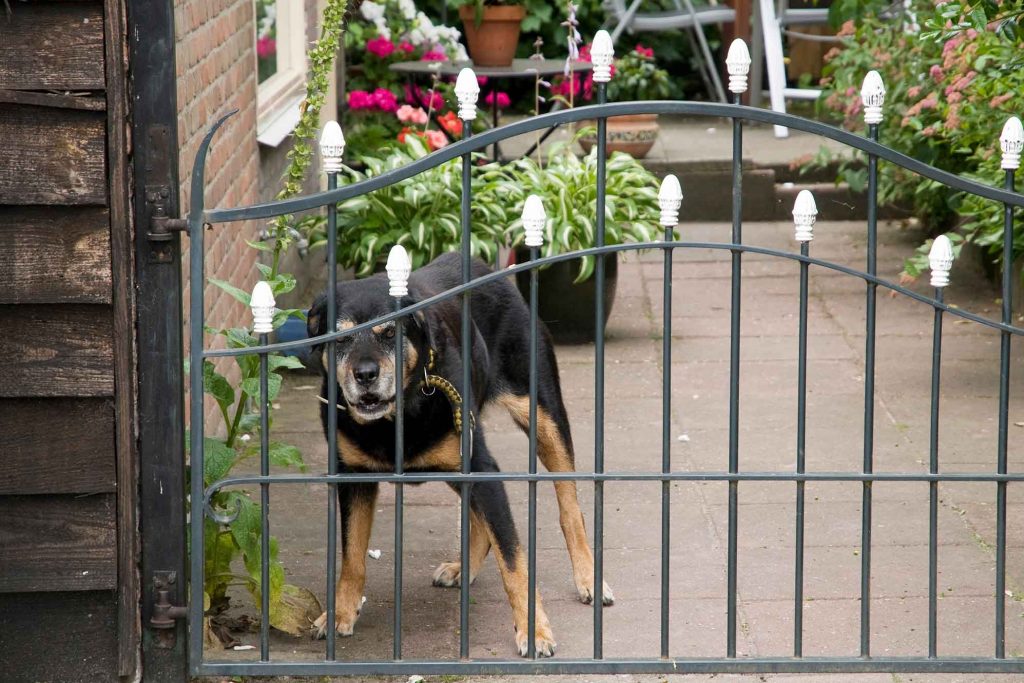
Barrier aggression can escalate quickly and result in euthanasia if this issue is not taken seriously. Barriers, such as; fences, gates, windows, screen doors, balconies have the potential to generate high levels of frustration and stress, resulting in incessant barking, or worse, aggression.
Barriers “train” dogs to become hyper-territorial because it has a built in reinforcement mechanism: people come, people go. People approach the barrier – resident dog barks – people retreat from barrier. The dog, unaware that this was their intention all along, pats himself on the back for a job well done. The same pent up aggression can occur with dogs, cats, squirrels and birds.
Why is this a problem? I want my dog to be territorial.
One benefit to having a dog is knowing that the dog may help deter intruders. The problem is the rate at which territorial behavior can snowball when dogs are left to their own devices. True protection dogs are trained to have an “on” AND an “off” switch. Dogs that are left outside unattended, for example, never learn how to “turn it off.”
Bites occur when gates pop open unexpectedly, or when you invite a friend to bypass the front door and walk into the yard. Postal workers rack up the most serious dog bites, because dogs have a well established reinforcement history of “barking them off the premises.” The day that the postal worker needs to deliver a package to the front door, is the same day that the dog will deliver a bite. The problem becomes even more serious when a nervous dog learns to transfer this aggressive behavior to other social situations.
What to Do If Your Dog is Barking by the Fence:
#1 Supervise Your Dog Outside.
Opening the door and allowing dogs to go outside unattended can set the stage for problematic behavior, especially in young dogs or those with a history of excessive barking. Accompany your dog outside for potty breaks. Think of your backyard as your very own privately owned park. Make outside time more interactive by practicing the training recommended below. The best way to manage excessive barking is to keep your dog on a six foot leash or 10-15 foot long line whenever they are in the yard, and be present.
#2 Work on these Three Training Skills
For me, there are three skills that any dog will benefit from to prevent or minimize barking in the yard. Dogs are very context specific, so if you want your dog to be more responsive in your yard make sure you are practicing in your yard.
Check-ins
The first skill is to teach your dog to check-in with distractions. A check-in exercise is when you reinforce your dog for acknowledging a distraction and then looking back in your direction. This helps dogs learn to be calmer and less impulsive with common distractions and will decrease the frequency with which your dog alert barks with neighborhood activity.
“Come” When Called
Teaching your dog to come when called is also referred to as a “Recall.” In order to recall your dog in more challenging situations you need to start the training with mild distractions. Systematically work your way up the ladder of difficulty
Build enthusiastic responses by using high value reinforcement. Recall training could be a life saver – especially if someone forgets to close the gate properly or if there is a dangerous animal lurking around your property. This means that when it comes to building strong, reliable responses to your recall cue you will want to use “super treats,” save small bits of tasty foods (like steak or chicken) and use this to reinforce your dog whenever you call them in from the backyard.
Once your dog is responding reliably to your recall cue in more controlled set ups, you can use it to call your dog away from environmental distractions. You can even use if they alert to sounds or activity that may otherwise trigger barking.
Mat Work
The third skill is to work on relaxation exercises on a training mat. I also refer to this as “mat work.” This is not an obedience exercise where you are “commanding” your dog to stay on their mat with the use of verbal cues. Instead, this is a “conditioning” exercise that will help your dog shift into a calmer, more relaxed state with practice and repetition.
Reinforce your dog for calm behavior on their training mat when you walk to the door, touch the door knob, open the door or if they appear to be acknowledging any sights, sounds or smells from the outside. You can do the same thing out in the yard when you notice that they see or hear things in the environment that might ultimately result in barking.
Be proactive and train when your dog is relatively calm, this will set the stage for success in more challenging situations.
You want these skill sets to become automatic. In order to make this happen, try doing short 5 minute sessions once or twice each day. Short sessions usually create the strongest results in training because your dog will start to look at these sessions as a fun and rewarding way to connect with you. The intensity, frequ
Behavioral Training Classes
The remaining tips will look at how to supercharge your training to make sure that you are getting the most out of the time you are putting into your training. If you’re interested in training with me, take a look at my online classes. Follow along with a well structured training plan that breaks these skills sets down into easy to follow steps. If you sign up for my live online sessions you will also learn about how to integrate these exercises into your dog’s specific triggers. These classes are specifically designed to address anxious, fearful, hyperactive or aggressive behavior.
Chain link fences + unsupervised time outside + a dog that is predisposed to territorial behavior is a perfect cocktail for barrier aggression.
Whenever possible, choose solid fences that will better insulate your dog from environmental sounds and activities. This will also do a better job of keeping your dog safe from other dogs, wildlife or kids that might provoke or taunt your dog.
If a solid wooden or vinyl fence is not an option, the next best thing is to create visual barriers. Hedges are a good long term plan, while tarps will work best in the short term.
Another alternative is to create an inner fence line that would create more of a buffer from sounds and nearby activity. Use spring loaded hinges or some other automatic closing mechanism whenever possible to make sure that gates are never left open unintentionally. As mentioned earlier, bites are most common when gates or doors pop open unexpectedly.
#4 Choose Your Reinforcement Wisely
If your dog is excited for meal time it’s a great idea to use your dog’s meals. Your dog will be happier and healthier if you throw away the dog food bowl, or at the very least take them out of the mix for 2-4 weeks.
Do training at meal time instead. This will also help you be consistent with the training. Good training is about being consistent. It’s not what you do for a day or a week, but what your routine looks like each day.
All dogs can benefit from being on a good feeding schedule, but for even stronger results – use a high value training food. My go to is typically happy howie rolls or diced up chicken. Aim for a food that is moist, meaty and nutritious. If you want to learn how to get your dog more excited about meals, take a look at my video “How to Create a Healthy Feeding Routine.”
A “Random Bit of Advice”
I used to live in New York, and one time when my dogs and I were enjoying off leash hours at Prospect Park an old man randomly gave me a bit of advice. He said, “if you want a perfect recall – use liverwurst.” And then he just walked off. I’ll never forget it. But it does beg the question – what’s your dog’s holy grail when it comes to training food? Find that super treat that makes your dog act like they are on cloud 9. Use that for your recall.
Tip #5: Make Training Fun
Incorporate fun break activities into every training session. I like to do 15-30 second training sets that build value for check-ins, recalls and mat work. Then give your dog a break. Here are three fun break activities that you can incorporate into each session in order to supercharge your training.
Option 1
For dogs that have high toy drive – play a 1 minute game of fetch or tug.
Option 2
Other dogs might want to spend their break sniffing the yard or searching for wildlife.
Option 3
Play a quick game of hide and seek by tossing a handful of food into a towel and then running off behind a tree or bush. Call your dog and reinforce them once they find you.
Good training builds value for being calm and attentive in the presence of distractions, but it should also give your dog time to just .. be a dog.
Avoid playing long, mindless or repetitive games of fetch. Long games of fetch can create an adrenaline junky, leading to a dog that is even more fired up and frantic after the play session ends. Think of the labrador that doesn’t stop barking until you throw the next ball.
This could also make some dogs even more fired up with environmental sounds and activities.
The healthiest play sessions involve a lot of “start and stop” patterns. Think of red light, green light or freeze tag. The rules of the game involve running excitedly – freezing – and then running again. This helps kids think through excitement and improves their impulse control. The same thing is true with our dogs. This is why I like sandwiching high arousal activity, in-between calming exercises when I am working to teach arousal control.
Tip #6:Motivate Yourself to do the Training.
Make sure that the training is fun for your dog, but also for you! Being creative about how you implement the training might also help you be more consistent. For example, set up agility obstacles in your yard or create search games. Practice check-ins and recalls in combination with these activities. The more you enjoy the training, the more likely you are to stick with the training and the more likely you are to see results.
Frequently Asked Questions
What if my dog starts barking, pulls to the fence and doesn’t take food?
Go back inside for 10-15 minutes. Work on calming exercises back inside the house will have two benefits. First, moving to a more relaxing environment will help your dog learn to de-escalate faster. Second, with repetition your dog will become more excited and responsive when you ask him or her to come back into the house.
You will be especially thankful for this training on wet or cold nights where your dog happily comes running back to the house when you call them, and you no longer have to go searching for them in your pajamas.
Can I use a bark collar to address the barking?
Avoid the use of aversive tools or techniques to suppress fence barking. These approaches may appear to work in the short-term, but long-term your dog’s protective nature can become more intense and less predictable. If you do use aversive tools to address barking at the fence, you are likely to see an increase in aggressive behavior for two reasons.
Reason 1
First, pairing the sight and sound of people, kids or other dogs with aversive outcomes is likely to heighten stress levels associated with their presence.
Reason 2
Second, without clear warning signs, like barking, a person may approach or interact with your dog through the fence line. This further increases the probability of a bite when an adult or child unknowingly attempts to pet your dog through the fence.
This is also true with electronic fences. But they can create an even bigger problem in that these invisible barriers frequently fail when a dog’s level of arousal and adrenaline is so high that they plow through the barrier. For example, a dog might respect the barrier until they see a squirrel or another dog. A high level of adrenaline can numb the dog to the sensation of the shock.
The same is not true when the dog attempts to cross the barrier in the opposite direction. In this case, the electronic fence would actually discourage the dog from coming home.
Tell Me About Your Dog
What are your dogs biggest triggers? How do you see yourself using the information in this video to help address or prevent your dog from barking through barriers?
Bringing home a new baby can be stressful for the family, but can also be confusing for your dog. Let me share with you some tips that can help with Introducing your dog to the baby and allow your dog make sense of whats going. These tips will help ensure that your dog will share in the happiness of your growing family.
Tip #1: Brush up on basic obedience
Practice relaxation exercises on a blanket in preparation for nap time or nursing. Teach your dog how to walk on a loose leash so that you, your baby, and your dog can enjoy long strolls through the neighborhood.
Tip #2: Play audio clips from YouTube of a baby crying
Babies are going to cry and this can be super stressful for your dog. So that your pup gets familiar with the sound that will inevitably be going on for some time to come, go on Youtube and play audio clips of a baby crying. Keep the volume low to start, and gradually increase it so long as your dog is exhibiting calm, relaxed body language. During this time you can also provide your pup with high value treats to create a positive association with noises that might otherwise generate anxiety.
Tip #3: Manage their greetings
Most dogs are scolded for an over exuberant greeting when mom first comes home from the hospital, this can make for a stressful introduction to family life. Rather than being reactive to this type of greeting, plan for it by introducing your dog to the baby through proper management.
Here’s what you should do when coming home from the hospital. Dad (or partner) should wait outside with the baby and Mom should come inside alone to greet the dog, put him on leash, and reward calm behavior with high value treats. If the dog is calm when Dad comes in with the baby, you can allow the dog to sniff at the baby’s toes. If the dog seems nervous, or overly-excited, lead the dog to a training mat and provide reinforcement when he targets the mat. When in doubt, err on the side of caution, and save the introduction for a later time when the dog is more relaxed.
Tip #4: Read body language
Brush up on canine body language and stress signals, and use this knowledge to read your dog when he is around infants, toddlers, strangers and unfamiliar objects. If you notice early warning signs of fear or anxiety, you can set-up an online behavior consultation for tips on how to improve your dog’s social skills and to help them feel more comfortable.
Tip #5: Create a dog safe place
Creating a safe place for your dog is extremely important. Initially, this will be a place that your dog can retreat to when the baby is crying, or when you have a lot of visitors. As time goes on this will be a good place for your dog to sneak away to get some rest when your baby becomes mobile, and develops a deep, and unrelenting fascination for her four-legged-furry-sibling.
We use cookies to ensure that we give you the best experience on our website. If you continue to use this site we will assume that you are happy with it.