Category: Uncategorized

  • 10 Common Mistakes People Make In Behavioral Training

    10 Common Mistakes People Make In Behavioral Training

    When training doesn’t go to plan it’s common for people to blame the dog. Instead you should ask yourself how you can be a more effective teacher. This blog looks at common mistakes in behavioral training and what can be done instead to work through problem behaviors associated with fear, anxiety, aggression or hyper-activity.

    Mistake # 1: Avoid stifling reactive or excitable behavior

    Stifling or suppressing behavior is a short term fix that can lead to more stress, frustration and anxiety. Suppressing behavior has the potential to create more intense and less predictable behavior in the long term.

    The Solution

    We need to train proactively, not reactively. Train in situations in which your dog is able to offer calm and engaged behavior *with ease*, and systematically build towards more challenging real world scenarios.

    Mistake #2: Doing “too much, too soon”

    We try to train in situations that are beyond our dog’s capabilities.

    The Solution

    You need to break down one big goal into smaller, achievable steps. If you feel stressed or frustrated by the training, your dog probably feels the same way. Breaking things down ensures that you and your dog are set up for success every step of the way.

    Mistake # 3: Training without a management plan

    Our dog’s environment and routine shapes behavior. If your routine puts your dog into situations where they frequently practice undesirable behavior, like barking, lunging or snapping, those behaviors will become more habitual and more difficult to modify.

    The Solution

    Sit down and come up with a solid management protocol that will minimize or prevent exposure to triggers that generate undesirable behavior. Stick with the protocol for a 3 month block of time, or longer, even as your dog begins to make progress in training. It’s important to give your dog plenty of time to practice healthier habits, before you “take off the training wheels.” (so to speak)

    Mistake #4: Trying to stop bad habits, instead of creating good habits

    There’s only so much progress that we can make when we focus on what we don’t want, instead of focusing on what we do want.

    The Solution

    Start training simple behaviors that can replace undesirable behavior. For example, teaching your dog to check in with you in the presence of distractions is a great way to work through behavioral issues related to high stress or over arousal.

    Mistake # 5: Blaming failure on your dog

    People will say things like “he knows better” “he’s stubborn/ dumb/ defiant/ or dominant.” These labels create false assumptions about a dog’s motivation and abilities.

    The Solution

    Set the stage for success. If training ever feels like you’re “pulling teeth” that’s a good indication that criteria or training conditions need to be adjusted.

    Mistake #6: We underestimate the power of environmental cues

    A lot of times when we think about training we think of verbal cues. We fail to realize that the environment is also teaching our dog to behave in a certain way.

    The Solution

    Stop putting so much emphasis on verbal cues. Train your dog to freely **offer** behaviors. Then teach your dog to offer those behaviors in response to environmental distractions.

    Mistake #7: Believing that our dog “knows better”

    There are times where we go “over threshold” in our day to day routine. Times where we lose rational thought, struggle to control impulsive behavior, or communicate effectively with others. The same is true of our dogs.

    The Solution

    Your dog’s behavior is a reflection of underlying physiological responses, like elevated cortisol levels and adrenaline (stress hormones). The best thing to do if your dog appears stressed or over-aroused is to practice calming exercises that conditions calm responses with triggers. The same exercises should improve communication, trust and help your dog feel safe.

    Mistake #8: We focus on abstract goals, instead of concrete behaviors

    Try as you might you can’t make your dog be social with people or dogs if they don’t want to. In fact, our best efforts, bringing a nervous dog to a dog park or to social gatherings, usually backfire.

    The Solution

    Focus on well defined behaviors. If your dog is nervous in social situations you should focus on teaching them what they should do when they are stressed, like checking in with you or moving away from the trigger. Training should focus on actionable steps that are easy to follow.

    Mistake #9: Placing too much emphasis on good or bad days

    Training is a process. Every dog, just like every person, has good and bad days. This can lead people to stop training if their dog seems to be doing better or get frustrated and quit if their dog has a rough day.

    The Solution

    Be steady and consistent. Create a well thought out training and management plan and then stick with the protocol. Have a clear understanding of how to adjust conditions to your dog’s ever changing needs. Having a training “flow chart” will help you work through the tough days, it will also help you know how to advance your training if your dog is ready for the next step.

    Mistake #10: Assuming that change is impossible

    A negative mindset is the biggest obstacle to positive change.

    The Solution

    You gotta believe. Even on the hardest days you need to know that change is possible. It all comes down to knowing how to create the necessary stepping stones. Effective training breaks goals down into achievable steps that are fun and engaging for both you and your dog.

    Join the Discussion

    What was your biggest take away from this article? Join the discussion on this Facebook page: Behavioral Training for Anxious and Reactive Dogs. Please be sure to subscribe for more videos on Youtube and leave a comment on this blog page.
  • How To Crate Train a Puppy

    How To Crate Train a Puppy

    Crates can be useful for travel, if your dog ever needs to stay at the vet, or to keep puppies safe and out of trouble for short periods during the day. 

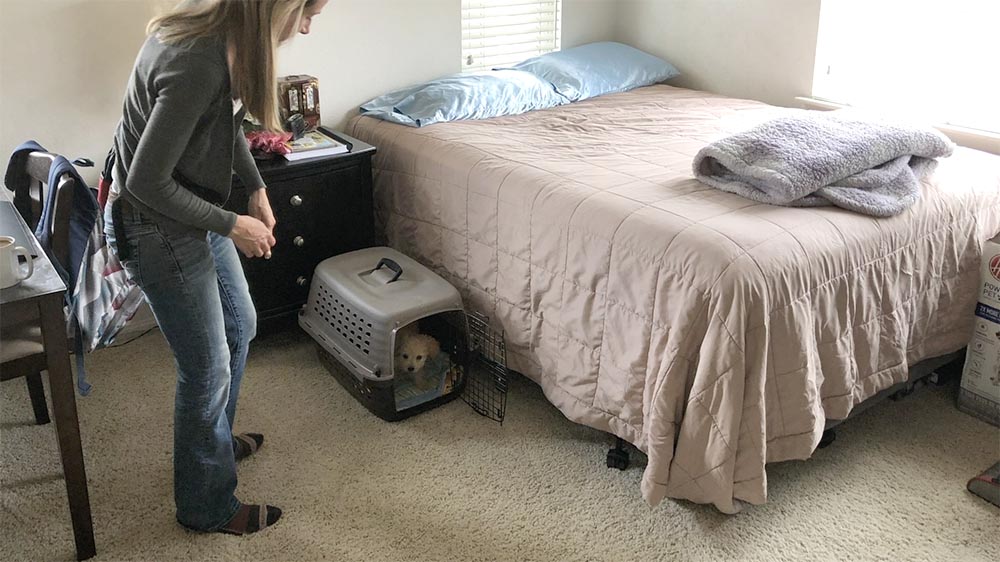
    woman with grey shit and blue jeans standing in bedroom while puppy is relaxing in crate

    Crates can also be used for puppies at night, while they sleep. Dogs are social animals, it’s ideal to place a crate right next to the bed so that they still feel safe in close proximity to you. 

    Avoid using a closed door crate for more than 1-2 hours during the day. Overuse of crates can be detrimental to a puppy or adult dog’s emotional and physical well-being. 

    It’s a great idea to leave an open door crate inside of a gated area or exercise pen. This will allow your puppy to enter or exit the crate of his or her own choosing and will set the stage for a puppy that has a safe, secure place to stay if they need to be left alone.

    Let me show you how to introduce this gated area to your puppy so that your puppy develops positive associations with this space and it can ultimately be used for alone time when you are taking a shower or if you need to leave the house.

    These training exercises require a high rate of reinforcement. In some cases you can use your puppy’s meals for training. You can also supplement those meals with a moist, meaty, nutritious training food that can be easily broken into small pieces without crumbling.

    Step 1: Positive Associations with a Mat

    woman in black shirt and blue jeans sitting in kitchen floor hand feeding puppy on a red training mat

    Start off by offering food on a training mat. Be generous with your reinforcement.

    Reinforce for 15-20 second periods of time. Calmly say the word “good” with a warm, genuine voice as you feed your puppy. Avoid giving your dog a verbal cue, like “go to place” or “stay.” Leaving these verbal cues out of the picture will help your puppy learn to offer these behaviors without always having to hear a cue.

    Step 2: Positive Associations with the Crate

    woman with black shirt reaching into puppy crate to scatter food

    Teach your puppy that the crate offers an abundance of good things. Place their training mat inside the crate and then scatter food on the mat. Give your puppy the opportunity to walk in on their own four paws. Patience is key. Avoid the temptation to push or place your puppy inside the crate. The end goal is to have a puppy who happily and willingly walks inside of their own choosing.

    Step 3: The Turnaround

    woman in black shirt deliver a treat to puppy in crate who is turning around

    Capture and reinforce your puppy the moment that they turn back in your direction. Be generous and offer them as many rewards as possible before they have the opportunity to walk out. 

    If and when your puppy walks out of the crate – freeze and withhold food for about 5 seconds – before placing a little piece of food back inside the crate. With repetition your puppy will learn to orient towards the crate, even if you’re sitting there with food in hand. Remember not to use the word “crate” or “stay” or “no” – we want the puppy to be problem solving, and to ultimately offer these behaviors on their own without needing to hear the cue.

    Step 4: Stepping Away, Return and Reinforce

    puppy relaxing in crate within a gated area in the kitchen

    Once your puppy is choosing to go in the crate of his or her own choosing and seems to be settling inside, you can begin to raise criteria. I very rarely leave puppies in a closed door crate during the day. Instead, I like to train puppies to use open door crate crates inside of a gated area or exercise pen. To teach the puppy to settle inside of a gated space, you can step on the other side of the gate. Take a step or two away and then step back and reinforce your puppy. Repeat this a few times over before opening the gate and giving your puppy a break.

    Step 5: Break Time

    puppy taking a break and drinking some water in the kitchen

    You can encourage your puppy to take a break by drumming on the ground in front of the crate. The break will give your puppy an opportunity to get a drink of water, to give your puppy an opportunity to potty or to just .. hang out.  The best learning happens when puppies have short intervals of time to step away from the training, and process newly acquired information. 

    In the early stages, the break should be relatively calm. You don’t want your break activity to overshadow your training. After your puppy takes a 30-60 second break you might find that your puppy is ready to walk back to his crate in anticipation of more training. If this becomes a common occurrence, your puppy might be ready to move to the next step.

    Step 6: I’ll Back in a Flash

    woman with white shirt and blue jeans creating some distance away from the puppy in a crate within a gated area

    It’s a good sign when your puppy starts to trot back to their crate after a short break. If my puppy appears calm and relaxed with me on the other side of a gate I will:

    • Grab something from a nearby table, walk back and reinforce
    • Step out of sight for a second, walk back and reinforce
    • Sit down on the couch for 5 seconds, walk back and reinforce

    How Often Should I Practice?

    flow chart explaining what to do if you notice certain stress signals

    What if my puppy stops taking food, begins to stress whine, bark, bite or scratch at the gate? If you see any signs that your puppy is distressed: give your puppy a break. When you come back to training, work on a more basic version of the same exercise.

    Drop back to a variation of the training where your puppy offered a higher level of success. You can always build from calm, confident behavior.

    When Can I Leave My Puppy Alone?

    Make training part of your daily routine with your puppy. You can use breakfast and dinner as an opportunity to connect with your puppy and build value for calm behavior inside of “safe space.” 

    Practice these exercises for 5 minutes, once or twice a day for 5-10 days. If you are not consistent with the training, or if your puppy already has a negative association with the space or with the crate – you may need more time.

    Step 7: The Final Touches

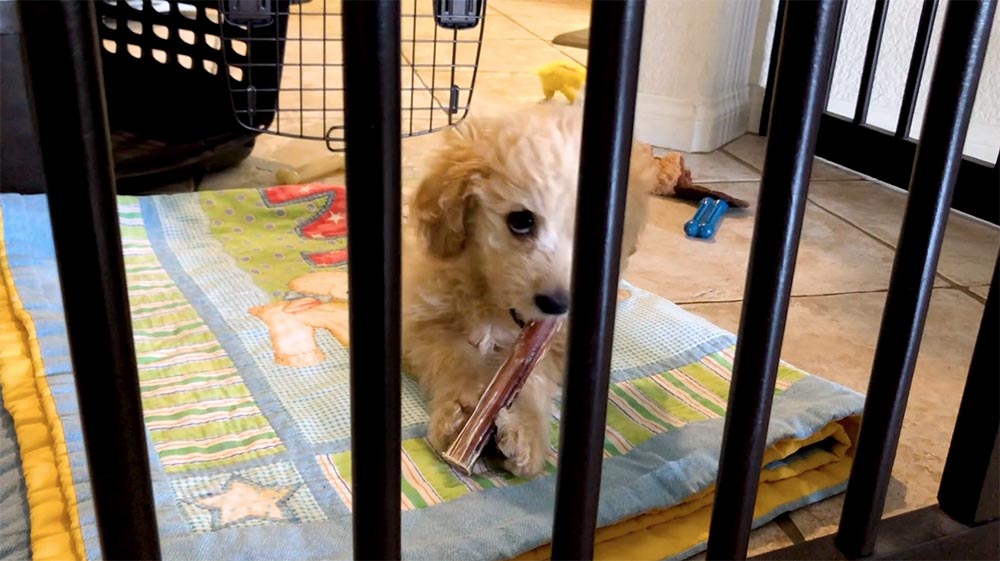
    puppy chewing on a bully stick on a blanket on the kitchen floor

    To close the gap between these formal training sessions and practical use of this space.

    I will start off by having the puppy in their safe space with a special chewie while I take out the trash or water the outside plants. 

    When you do this, it’s ideal if the puppy has already had other mental and physical needs met. For example, I might do a short play session, make sure they have an opportunity to go potty and sit outside with them for 10-20 minutes for a “watch the world” session. If their physical and mental needs are already met, they are more likely to curl up for a nap once they walk inside their gated safe space. 

    woman with grey shirt drinking coffee and relaxing on couch with 2 adult dogs

    I personally love having my adult dogs up on the couch with me, or sleeping in my bed at night. That being said, if I’m raising a puppy I like to set them up so that the majority of naps and nighttime sleep happens in their gated safe space or a crate. 

    I make sure that the coziest spot to take a nap during the day is inside an open door crate. I also usually have a puppy sleep in a closed door crate next to my bed at night in their first year. The more that a puppy associates the crate and/or their gated area with rest and relaxation – the calmer your dog will be when you have to leave them alone, to take a shower, leave the house, or if they have to stay at the vet. 

    This space also becomes incredibly valuable when you are trying to calm your puppy piranha. 

    If you have an adult dog that you are trying to crate train, check out How to Crate Train an Older Dog in 7 Simple Steps.

    Let me know if you found this helpful. Please be sure to subscribe for more videos on Youtube and leave a comment on this blog page.

  • Dog Behavior Training is Like Meditation

    Dog Behavior Training is Like Meditation

    In many ways behavioral training is all about mindfulness. Let me share with you five similarities between behavioral training and a mindfulness meditation practice.

    1. A Relaxing Start

    black dog relaxing on turf next to a woman with orange jacket

    It is important to start training off in a low stress, low distraction environment in the same way that meditation is generally practiced in a quiet room with candles and relaxing music. It can take time to work up to “Times Square” level distractions.

    2. A Mindfulness Mat

    dog trainer working with a belgian malinois on a red mindfulness mat

    Calming exercises with your dog will be done in combination with a comfortable mat, just like meditation is initially practiced when sitting on a pillow or in a comfy chair.

    3. Thinking Through Challenging Situations

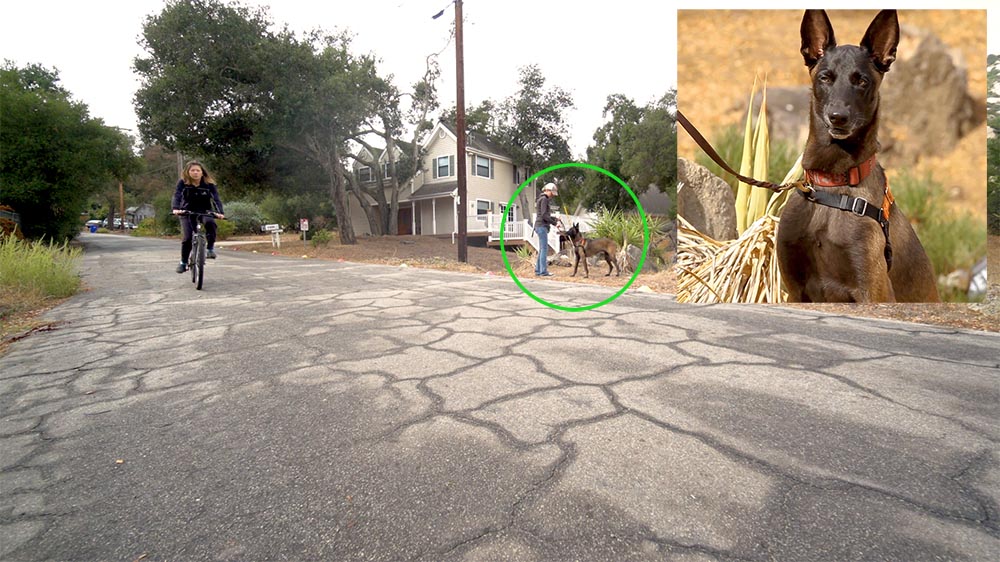
    belgian malinois dog training through challenging situation with woman riding on bike in street

    In the same way that we go over threshold in our day to day lives our dogs can also hit their limits.  With help your dog can improve their ability to think through stress or over-arousal.

    4. The “Carry Over

    dad and daughter sitting in green grass with a happy and calm dog

    These exercises, once established, can be used to promote calm behavior throughout your dog’s day, in your home, on walks, in any context. Similar to the way that practicing meditation can carry over to many different situations in our own lives. 

    5. Creating Joy

    light brown small dog very happy being pet by woman

    Behavioral training is about bringing out the best version of your dog by minimizing stress and enhancing communication. The result is a joyful and harmonious relationship with your dog.

    Let me know if you found this helpful. Please be sure to subscribe for more videos on Youtube and leave a comment on this blog page.

  • Food at Work in Shaping Behavior in Animals

    Food at Work in Shaping Behavior in Animals

    Food Shapes Behavior

    The acquisition of food shapes behavior. Birds, foxes, ants, and bears – all animals – learn and practice behaviors that result in the acquisition of viable food. Their ability to forage, track, chase and hunt are all behaviors that are fine tuned on a daily basis.

    Regulating Emotional Responses

    Not only does the acquisition of food shape behavior, but it also regulates emotional responses, strengthens bonds for those species that live within social constructs and enhances problem solving skills. In essence it is what makes them mentally and physically fit to survive in the world in which they live.

    The Dog Bowl

    Taking all this into account, it’s easy to see why feeding dogs in a dog bowl leaves a lot of empty space in a dog’s routine. The mental and physical energy that would normally be utilized by the dog’s brain and body can otherwise fuel the most common behavioral issues like reactive, anxious or aggressive behavior.

    Using Food for Training and Enrichment

    This should be an everyday occurrence. It can be used to promote calm behavior in your home, to provide mental workouts, to strengthen social and emotional skill sets and it can help your dog thrive. 

    Being a dog in our busy, modern world isn’t always easy. Training is the best way to offer guidance and bridge the divide.

    Let me know if you found this helpful. Please be sure to subscribe for more videos on Youtube and leave a comment on this blog page.

  • How to Train a Fearful Dog

    How to Train a Fearful Dog

    Dog Profile

    Specs

    Beatrix a 12 pound terrier mix. Initial training began at 11 months of age.

    History

    Beatrix was rescued from the city shelter at 8 months of age, she was picked up as a stray.

    Behavioral Concern

    People entering the house. Beatrix exhibited fearful behavior, like running away when she saw people on walks, and barking when people entered the home. In some cases, she attempted to nip at people’s heels. Her behavior with guests persisted long after the person had entered the home, and regardless of how many times she had met an individual.

    The Process

    Step 1: Setting goals and expectations

    The goal here was to minimize stress, and teach her to check in or go to her training mat whenever she became nervous or uncertain.

    Step 2: Implement Management Strategies

    When guests came over, we used a harness and leash.

    • We asked guests to ignore Beatrix, even if she approached to sniff.
    • We kept Beatrix in a bedroom, where she felt safe, when training wasn’t possible
    • We avoided taking her places where we expected she would be overwhelmed.

    Step 3: We established base training

    We worked on skill sets outlined in the online classes I teach. This included training check-ins with controlled distractions, as well as mat work with duration, distraction and distance. These exercises created a strong reinforcement history for being calm and engaged, it also put focused, engaged behavior on cue.

    Step 4: We integrated unfamiliar people into set-ups

    The goal was to create conditions in which Beatrix was capable of acknowledging a person without reacting. A successful session was measured by an increase in focus, engagement and relaxed body language over the course of 5 minutes of training.

    Step 5: Integrating Training into Real World Scenarios

    Once Beatrix was responding well to set-ups in neutral environments, we started practicing the training in less controlled scenarios at home with a significant level of success.

    In Conclusion

    In general, keep your dog on leash if you have any concerns that they might bark, charge or nip at guests in the house. 

    Management and training is still implemented based off of Beatrix’s behavior and body language. Overall, the intensity of fearful behavior and the time it takes her to recover has diminished. Her threshold has increased and her ability to connect and respond to cues has greatly improved as a result of the training I implemented

    Beatrix is now capable of being calm and engaged in situations that would have previously triggered barking, lunging or running away. The training has given her the opportunity to be more engaged in our day to day activity and family adventures.

    Let me know if you found this helpful. Please be sure to subscribe for more videos on Youtube and leave a comment on this blog page.

  • Do’s and Don’ts of Helping Dogs to Become Friends

    Do’s and Don’ts of Helping Dogs to Become Friends

    This article applies to initial dog-dog introductions, as well as, those dogs that need “relationship therapy” due to fighting or tension that arises in their day to day routine. 

    Neutrality

    Minimize friction by being proactive. Put away the toys, keep bones in the cabinet, block access to socially significant “hot spots” where fights are most likely to occur (ie. sofas, beds, doorway thresholds), and avoid giving attention that could potentially generate conflict. Preventing fights through management is a critical part of helping two dogs develop a strong relationship. Stick with the protocol and re-assess your management protocol every 6 weeks. Every altercation could extend the training timeline. Erring on the side of caution typically leads to the best results.

    Forge a Bond Through Shared Experiences

    Take them for slow walks in new places. Exploring neutral territory is a great bonding activity. Be cautious if one or both dogs are reactive on leash. You might choose to walk on quiet trails where walks will be most relaxing and you are less likely to run into triggers.

    Parallel Training

    Place two training mats on the ground and reinforce your dogs for being at separate stations. “One for you, one for you.” This is a great way to establish calm, positive association in each other’s presence. Work on these exercises once or twice each day. To create a safe training set up for dogs that cannot co-exist in the same space, or that fight over food or attention, you can place one mat on the opposite side of a baby gate.

    What to do if and when you notice tension (ie. a hard stare, growling, snarling)

    Be Calm. Aggression stems from stress. Yelling or physically reprimanding a dog for aggressive behavior usually adds more fuel to the fire and can intensify subsequent fights. Be Prepared. When your dogs are supervised, have dogs on a harness, dragging a short leash. If there is tension between the two dogs – pick up the leash and lead him/her away from the other dog. When it makes sense, reinforce your dog for moving away from conflict. Try to avoid grabbing a dog’s collar when you notice tension, as this is often a sure fire way to start a fight. Keep a behavior log. Write down the date, time, location, observable behaviors, as well as, any other factors that may have contributed to the incident. This will help in establishing and implementing a more effective management and training plan. 

    Warning Signs are Good!

    Be thankful for growling, snarling and air snaps; this is a dog’s way of communicating that they are feeling stressed, and is the perfect time to calmly diffuse the situation. Many people want to “correct” their dog for  exhibiting these signs, and believe that this is the best way to “teach a dog not to be aggressive.” In reality, they are only addressing the symptoms – not the underlying cause of the problem. The other unfortunate side-effect of “correcting” warning signs is that your dog will learn to suppress warning signs, and go straight into fight mode. Have you ever heard people say “My dog attacked without warning”? This is usually because the dog was trained not to give a warning. Corrections can suppress behavior in the short-term, but in the long-term aggressive behavior can become more intense and less predictable.

    What to Do If Your Dogs Fight

    After you break up the fight you should secure both dogs on harness and leash and move them both to an environment that is more conducive to relaxation. Changing the environment can help them transition to a calmer state of mind. Reintroducing dogs in a calm, safe and controlled manner will ensure that neither dog will harbor resentment and make the rivalry worse.

  • 10 Things You Need to Know About Aggressive Behavior in Dogs

    10 Things You Need to Know About Aggressive Behavior in Dogs

    [et_pb_section admin_label=”section”] [et_pb_row admin_label=”row”] [et_pb_column type=”4_4″][et_pb_text admin_label=”Text”]

    This article is intended to help dogs that bark, growl, lunge, charge, snap or bite when interacting with people or dogs. Stress, generalized anxiety, chronic stress, frustration, pain or underlying medical conditions can all contribute to aggressive responses. Address any potential medical issues with your veterinarian and read through these tips before creating and implementing a behavior modification plan for aggressive behavior.

    1. The Importance of Management With Aggression in Dogs

    Solid management strategies is a critical component of an effective behavior modification plan. The more a dog practices undesirable behavior, the more habitual those behaviors become. Create visual barricades to reduce the intensity and frequency with which your dog barks at people or dogs through windows or fences. Walk your dog at times and in areas that are quiet. Help your dog relax in a safe space in your house when you have visitors come over. These strategies will facilitate progress when paired with an effective training plan.

    2. Keep a Behavior Log of Aggressive Responses

    Person with a grey sweatshirt holding a grey pen and a white pad of paper ready to write information down

    In order to work through aggressive behavior, we first need to get really good at predicting when it will occur. This can minimize the number of times our dogs rehearse aggressive responses. Keep a behavior log and use it to write down concerning behavior when it occurs. Write down:

    • Date
    • Environment (ie living room, kitchen, backyard etc.)
    • Time of day
    • Conditions that surrounded the event (events, resources, activities)
    • Behavior (avoid labels like “vicious” or “defiant” – use terms that describe the actual behavior like “lunged” or “barked.”)
    • Recovery time (ie. how long did it take for your dog to return to calm?)

    3. Suppressing Symptomatic Behavior

    Verbally or physically reprimanding a dog for growling, barking or snapping can easily teach a dog to suppress warning signs of aggression. When people say, “the dog bit without warning” this is usually because the dog was “trained” not to give warning. Respect warning signs and create space by moving your dog away from a person, dog or event that is triggering aggressive behavior. Do not use verbal or physical reprimands/corrections to suppress warning signs of aggression, like hard stares, growling, barking or air snapping.

    4. What should I do if my dog delivers a bite?

    If a dog delivers a bite, you should neutralize the situation by moving the dog away on a secure leash and harness. Avoid restraining the dog by the collar, isolating a dog, yelling or hitting the dog in such a situation. All of these responses can intensify the underlying emotional response. Instead, focus on redirecting the dog to an activity that is inherently calming. For example, go for a walk or stand or sit with the dog in a calm environment.

    5. Ambiguous Behaviors

    Know that wagging tails, licking faces, sniffing or rolling over to expose a belly are ambiguous behaviors. Many people mistakenly assume that these are indications that the dog is friendly, and wants to be pet or that they want to be “friends” with another dog. Sometimes that’s true, and sometimes this is actually an “appeasement gesture” that the dog is displaying to express stress or discomfort. Forcing unwanted interactions is a fast way to teach a dog to express discomfort in a less ambiguous manner, for instance, biting. If a dog has history of being nervous, or has a history of aggressive behavior, err on the side of caution, and give the dog space.

    6. The Importance of Neutral Body Language

    Petting, talking to, or staring at a dog that is uncertain can trigger an aggressive response. It may take several meetings for a dog to become comfortable. Some dogs never warm up to certain people, and will always need space. Neutral body language and patience are the most effective ways to generate trust with a nervous dog.

    7. Avoid having Strangers Feed Your Nervous Dog

    High value food can be a great way to condition a dog to have a “feel good” response to the presence of people that may otherwise generate stress. However, food should always be delivered by a trusted caregiver, not from the hand of a stranger. Coaxing a dog to interact with or approach a person they are uncomfortable with can create a conflict of interest that could result in an escalation of stress, and could lead to a bite.

    8. Fences and Tight Leashes Can Fuel Aggressive Impulses

    Trainers that train police or protection dogs use barriers and tight leashes to generate aggressive behavior. Leaving dogs outside in a fenced yard or walking your dog on a short, tight leash can have a similar effect. This behavior can generalize to other social situations, like greeting guests or people that they see on walks. If you live in urban or suburban environments do these four things to minimize the amount that your dog practices barking at people or dogs:

    1. Keep your dog in a central area of your home when you are leave the house. Avoid leaving your dog in a yard unsupervised for extended periods of time.
    2. Create visual barriers to windows or fences to minimize exposure to environmental triggers, like people or dogs.
    3. Walk your dog on a six foot leash, as short leashes will exacerbate reactive behavior, like barking and lunging.
    4. Enroll in a training program that uses positive reinforcement training to minimize stress and/or arousal that would otherwise fuel your dog’s aggressive responses.

    9. Avoid Aversive Methods, Training Tools and “Techniques”

    Avoid trainers or training recommendations that promote the use of aversive training tools to “fix” or “rehabilitate” dogs with aggressive behavior. Slip collars, choke chains, throw chains, shaker cans, remote electronic collars, bark collars and alpha rolls are likely to suppress behavior in the short term, but can exacerbate the underlying issue long term. There is only so long that you can keep a lid on a boiling pot of water before it pops!

    10. Learn About Canine Stress Signals

    Learn about canine stress signals and the manner in which they present in your individual dog. Recognizing early signs of stress can afford us the opportunity to give our dog the space they need when they are overwhelmed by a person, dog, or activity.  Dogs will escalate to more intense aggressive behavior when early warning signs are unnoticed, dismissed or suppressed.

    10. Learn About Canine Stress Signals

    Learn about canine stress signals and the manner in which they present in your individual dog. Recognizing early signs of stress can afford us the opportunity to give our dog the space they need when they are overwhelmed by a person, dog, or activity.  Dogs will escalate to more intense aggressive behavior when early warning signs are unnoticed, dismissed or suppressed.

    [/et_pb_text][/et_pb_column] [/et_pb_row] [/et_pb_section]
  • Five Secrets to Successful Adoptions!

    Five Secrets to Successful Adoptions!

    [et_pb_section fb_built=”1″ admin_label=”section” _builder_version=”4.16″ global_colors_info=”{}” custom_padding=”||0px|||”][et_pb_row admin_label=”row” _builder_version=”4.16″ background_size=”initial” background_position=”top_left” background_repeat=”repeat” global_colors_info=”{}”][et_pb_column type=”4_4″ _builder_version=”4.16″ custom_padding=”|||” global_colors_info=”{}” custom_padding__hover=”|||”][et_pb_text admin_label=”Text” _builder_version=”4.16″ background_size=”initial” background_position=”top_left” background_repeat=”repeat” global_colors_info=”{}”]

    1: Housetraining

    Picture

    Beginning from the very FIRST SECOND that your dog enters your house, they are absorbing information like a sponge. If you’re smart – you’ll take advantage of this time and get your dog off on the right paw. Here’s how:

    When bringing a new dog into your home NEVER assume that house training will carry over. (Dogs don’t generalize well) Allowing your dog the opportunity to have accidents in the house in the first few days may set the stage for months of potty problems. Get your dog on the right track on Day 1 by vowing to prevent any accidents from occurring. These next three tips may seem like a lot of work but will save you time and frustration in the long run! Here’s what you need to do for the first 2-3 days (minimum):


        • Go for for potty breaks outside (on leash) every half-an-hour.

        • Reward when they do their business in the appropriate place.

        • Keep your dog on leash or in a confined area when they are in the house to prevent accidents.

      2: Separation Preparation

      Creating a “safe space” for your dog to stay in when unsupervised is preferred. I recommend gating off a kitchen, and spending time to properly proof the area to make it safe and secure:


          • Always be sure that your dog has been given the opportunity to potty and exercise before going into their “safe space.”

          • Provide irresistible goodies only if/when they are in this area.

        3: Establish a Healthy Routine

        Dogs thrive when given structure and clear-cut expectations. Sit down with your whole family and write up a list of “house rules” – your dog will thank-you for it! Here are some basic rules to consider implementing with your new dog.


            • Keep greetings and departures low key. Exuberant “hellos” can set the stage for unwanted behavior down the road; like jumping or barking. Long, drawn out, goodbyes could make your dog more anxious about being on his or her own.

            • Build value for being calm and connected. If a newly adopted dog is prone to anxious, fearful or hyper-active behavior it’s a great idea to spend 5 – 10 minutes each day hand feeding your dog their breakfast or dinner. This can create the bedrock for a great relationship.

            • Create a feeding schedule! Why shouldn’t you leave food out throughout the day? Scheduled feeding allows you to monitor your dog’s mental and physical health. Loss of appetite is usually the first indicator that something is wrong and your dog is in need of special attention. A good feeding schedule is also associated with greater learning potential and a more energetic, happier dog.

          4: Learn About Your Dog

          Read their body language, and take note of how your dog responds to different people, places, noises, environments etc. Be aware of your dog’s emotional state, and avoid pushing your dog into situations that appear to generate chronic stress or anxiety. Be your dog’s advocate. Being sensitive to your dog’s limitations is the first step in developing a trusting relationship. Dismissing clear indicators of stress or anxiety is a sure fire way to create unwanted behavioral issues.

          5: Expose Your Dog to New “Stuff” Gradually

          Go to big open parks where dogs have to be on leash (not a dog park!) where your dog can watch the world go by. Allowing your dog to see dogs and people in the distance is a great way to help your dog learn to be calm and minimize stress or arousal on leash.  This allows for more gradual exposure to stimuli that could otherwise over-stimulate or over-whelm your dog.

          [/et_pb_text][/et_pb_column][/et_pb_row][/et_pb_section][et_pb_section fb_built=”1″ _builder_version=”4.19.4″ _module_preset=”default” custom_padding=”0px||3px|||” global_colors_info=”{}” theme_builder_area=”post_content”][et_pb_row _builder_version=”4.19.4″ _module_preset=”default” custom_margin=”-10px|auto||auto||” custom_padding=”||8px|||” global_colors_info=”{}” theme_builder_area=”post_content”][et_pb_column type=”4_4″ _builder_version=”4.19.4″ _module_preset=”default” global_colors_info=”{}” theme_builder_area=”post_content”][et_pb_post_nav prev_text=”Previous Post” next_text=”Next Post” _builder_version=”4.19.4″ _module_preset=”default” global_colors_info=”{}” theme_builder_area=”post_content”][/et_pb_post_nav][/et_pb_column][/et_pb_row][/et_pb_section]
        • “My Dog Isn’t Food Motivated”

          “My Dog Isn’t Food Motivated”

          [et_pb_section fb_built=”1″ admin_label=”section” _builder_version=”4.16″ global_colors_info=”{}” custom_padding=”||0px|||”][et_pb_row admin_label=”row” _builder_version=”4.16″ background_size=”initial” background_position=”top_left” background_repeat=”repeat” global_colors_info=”{}”][et_pb_column type=”4_4″ _builder_version=”4.16″ custom_padding=”|||” global_colors_info=”{}” custom_padding__hover=”|||”][et_pb_text admin_label=”Text” _builder_version=”4.16″ background_size=”initial” background_position=”top_left” background_repeat=”repeat” global_colors_info=”{}”]

          First things first: if your dog has a pulse then your dog is indeed food motivated. A common thing I hear from people is that their dog isn’t that motivated towards food. Let me tell you about three possible reasons that your dog may no be excited about food.

          1. Overfeeding

          Dog food in metal bowl on old floor.

          The dehydrated food that most people feed is packed with calories and expands in a dog’s stomach. Combine that with all the extra treats that dogs receive each day and this usually equates to a dog that feels sickly just smelling more food. Here are a few hard and fast rules that will help improve your dog’s appetite if over-feeding is the issue. Here’s what you’re going to do:

          • Check with your vet to make sure there is no underlying physical cause for their reduced appetite. If your dog has a clean bill of health, keep reading ..
          • Use the quantity recommended on your dog food package to get a rough estimate of how much your dog should be eating. Keep in mind that that quantity is usually 5-10% than most dogs actually need. The dog food is a product, and the more you use, the more you buy.
          • Use a lined measuring cup! Stop using plastic containers and estimating, you should be precise in your measurements.
          • Pick up any food not eaten within 10 minutes. Dogs are opportunistic eaters. If your dog is walking away from the food then they are most likely receiving more than their daily caloric need. Assuming your dog is physically healthy, trust your dog to know that they’ve had enough.
          • If you are especially concerned that your dog might be hungry mid-day, you can always offer food again at lunch time. But do respect that the only way your dog can say “no thanks” is by turning their head away. Don’t force it.
          • Track the quantity of food that your dog chooses to eat for one week. That’s right … a full week. A full seven days. Measure and write down the quantity of food that is left over after 10 minutes and subtract that from the amount given.
          • Avoid adding gravy or wet food. If you feel the need to add a little something special you can grate some of the meaty roll into your dog’s food like you are adding in fresh pepper. This is often enough to stimulate your dog’s appetite.
          • Now average your amount together. And divide by the number by seven. If you feed twice each day, divide that number by 2.

          2. Stress, Fear and Anxiety

          Chronic stress can suppress a dog’s appetite. This leads most people to leave food out throughout the day, which can exacerbate the problem. Keep your dog on a feeding schedule. If your dog walks away from their food bowl, be sure to pick it up. Talk to a professional trainer that will help teach you how to build your dog’s confidence, and minimize his or her day to day stress.

          3. Medical Issues

          A sudden loss of appetite or change in eating habits could be an indication that your dog should be brought to the vet. This will be easier to spot in a dog that is already on a healthy feeding schedule.

          There are studies that show that small quantities of food are more effective at stimulating an animal’s appetite than a larger quantity of the same food. Biologically, brains are programmed to be suspicious of foods that are offered in abundance. With this in mind, here’s a tip that will get your dog excited about meal time: measure out the ideal quantity of food for the day based on your dog’s weight, age and activity, and offer it in smaller portions throughout the day.

          [/et_pb_text][/et_pb_column][/et_pb_row][/et_pb_section][et_pb_section fb_built=”1″ _builder_version=”4.19.4″ _module_preset=”default” custom_padding=”0px||3px|||” global_colors_info=”{}” theme_builder_area=”post_content”][et_pb_row _builder_version=”4.19.4″ _module_preset=”default” custom_margin=”-10px|auto||auto||” custom_padding=”8px||8px|||” global_colors_info=”{}” theme_builder_area=”post_content”][et_pb_column type=”4_4″ _builder_version=”4.19.4″ _module_preset=”default” global_colors_info=”{}” theme_builder_area=”post_content”][et_pb_post_nav prev_text=”Previous Post” next_text=”Next Post” _builder_version=”4.19.4″ _module_preset=”default” global_colors_info=”{}” theme_builder_area=”post_content”][/et_pb_post_nav][/et_pb_column][/et_pb_row][/et_pb_section]
        • The Jumpers & Biters: What to Do About It!

          The Jumpers & Biters: What to Do About It!

          [et_pb_section fb_built=”1″ admin_label=”section” _builder_version=”4.16″ global_colors_info=”{}” custom_padding=”||0px|||”][et_pb_row admin_label=”row” _builder_version=”4.16″ background_size=”initial” background_position=”top_left” background_repeat=”repeat” global_colors_info=”{}”][et_pb_column type=”4_4″ _builder_version=”4.16″ custom_padding=”|||” global_colors_info=”{}” custom_padding__hover=”|||”][et_pb_text admin_label=”Text” _builder_version=”4.16″ background_size=”initial” background_position=”top_left” background_repeat=”repeat” global_colors_info=”{}”]

          Impulsive Players

          Tell me if you’ve ever met a dog exhibits sudden and intense episodes of manic play where they jump and bite at your clothing or arms. It seems playful, but the dog is unable to pick up on cues from you that you’re not having a good time. When dogs exhibit one of these outbursts the owner is usually left feeling overwhelmed, frustrated, angry and in some cases … scared. In the aftermath of one of these episodes, people are left with long red welts, bruises and the occasional swollen lip. 

          This is different from typical jumping that occurs during greetings. While an excited greeter can still be frustrating, at least the behavior is predictable. It happens when family, friends or acquaintances walks through the front door and usually stops after about 5 minutes. The behavior that we’re discussing in this post usually catches the owner off guard. The root of the problem is more complicated than it might first appear. The jumping typically occurs when dog becomes over-stimulated (fearful, anxious, aroused) by the environment or by changes in the environment. The dog can go from 0 to 60 in a few seconds, and it takes substantially longer for the dog to “come back down” to calm.

          Commonalities in dogs that exhibit this type of behavior:

          These dogs usually spend, or have spent, a significant amount of time “cooped up.”

          • Meaning, they spend more than 4 hours in a kennel or crate during the day. In some cases, this is necessitated by the dog’s impulsive tendencies to jump up, chew on things, or surf table tops.

          Their outside time is usually filled with high stimulation activity.

          • To counter-balance the amount of time that they spend in-active, the owner might try to “tire the dog out” with long games of fetch, day care, frequently trips to the dog park or long runs. These dogs become accustomed to an “all or nothing” approach to living life. They have not spent a significant amount of time learning how to settle in high stimulation settings, and they are not learning how to regulate play.  In these cases, dogs are conditioned to become “adrenaline junkies,” anxiously waiting for the source of their next high stimulation activity. If it doesn’t come soon enough, these dogs will create a high stimulation event with their rough and tumble play.

          It’s common for owners to feel that these dogs need a firm hand.

          • When a dog acts out of line they usually try to roll the dog to their side, give the dog a hard stare, knee the dog in the chest or use other aversive training tools. A dog that is already on an adrenaline high is likely to respond to these challenges (intimidation or pain) by attempting to “match” the person’s combative approach. An aversive approach can, in some cases, suppress the behavior for a short period of time. But like a covered pot of boiling water, there is a limited amount of time before the dog blows their lid.

          Here are 6 Training Tips for Impulsive Players:

          Training Tip #1: Train together.

          Training is a way to help your dog improve their problem solving skills. Food puzzles are becoming more and more popular, however, it’s even better if the problem solving becomes a bonding activity between you and your dog. Train them to a high level of fluency on calming behaviors. For example, settling on a training mat or dog bed, sitting or lying down on a variety of surfaces or heeling by your side. Start in a low stress, low distraction environment. Once your dog looks like an obedience super star in your house or backyard, gradually build up to more challenging environments. Remember that learning is an on-going process, there is always room for growth.

          Training Tip #2: Ditch the Dog Food Bowl

          Animals spend the majority of their day working to acquire food. Even we spend the majority of our mental and physical energy working to put food on the table. Our domesticated dogs are given free meals. Sometimes we ask them to sit (or for some other trick) before meal time but that takes up the smallest fraction of their total energy. The excess mental and physical energy fuels the most common behavioral issues. If you want to do a better job of utilizing your dog’s brain power you should get rid of your dog’s food bowl, and start making them work for their food in training sessions. Your dog will thank you, and your relationship will flourish in ways you never thought possible. It’s a great idea to carry your dog’s meals on walks. Fill up your training pouch and stop at a nearby park to hand feed your dog. This is a great way to promote calm, engaged behavior on walks. A dog that is calm and engaged is less likely to pull on leash, and more likely to come back when called when they are off the leash. Every dog can benefit from doing this.

          Note:

          Use higher value (meaty) food reinforcement whenever you’re challenging your dog to learn a new behavior, or when you are trying to generalize a learned behavior to new distractions or or to a new environment.

          Training Tip #3: Teach them how to play.

          This jumping/mouthing behavior is the result of a mis-directed effort to “play.” Some of these dogs find playing with their toys to be less interesting/stimulating than jumping and mouthing at their owner’s arm. Other dogs have no clue what to do with a dog toy, they’ve never learned how to play. We need to teach them. I personally have found that teaching dogs to play tug with well outlined rules can be a very constructive way of teaching dogs to issue more impulse control. You can also play fetch. Regardless of the game, the most important tip is to s-l-o-w the game down. Trying to do a lot of high intensity play will only fuel their fire. Instead, get your dog to think and problem solve. It’s also important to keep your playtime short. For example, it’s best to do 5 minute play sessions, 2 or 3 times each day. Avoid long play sessions. People generally try to “tire dogs out” with long games of fetch or tug, when in reality the dogs are just becoming over-stimulated. End each play session with a decompression activity like a relaxing nature walk, or by giving them a high value chew.

          click here for a video regarding rules of play for tug

          This also helps them think through high arousal and learn to become more in tune to their owner’s facial expressions and body language. However, many owners feel uncomfortable playing tug because it feels too similar to the very behavior that they’re trying to un-train. If this is the case, you can also teach your dog to play structured games of fetch. Some dogs are natural retrievers, some are not. A good trainer can shape and build drive for this type of game if they effectively break down the sequence.

          Training Tip #4: Go for hikes with your dog.

          Man and his grey furry dog walking through the forest on a hiking trail together

          Instead of taking this type of dog to daycares or dog parks, where they are likely practicing high arousal play, take your dog for hikes, to the lake, or on trips to the beach. The sights and scents of nature is great therapy. It can help recondition your dog to slow down, and relate to you in a healthier way. It’s physical exercise that generally promotes a calm state of mind, and it’s good for you too.

          Training Tip #5: Condition your dog to a head halter.

          I will be honest, I don’t love head halters. I don’t like putting head halters on dogs, because most dogs don’t like wearing them. That being said, dogs that jump and bite at people (even if the dog is well intentioned) can cause injury, and these situations need to be managed intelligently. If your dog jumps and bites with guests, with kids, or when you are out on a walk you can use a head halter while you work on generalizing their training to these scenarios. A dog that paws incessantly at their halter or muzzle is not properly conditioned to wearing it. Make sure you spend time helping your dog to feel comfortable with the head halter by feeding them meals while they wear it. The head halter should not create additional stress, frustration or anxiety.

          Contact a trainer if you feel you are not able to tackle these challenges on your own.

          Go to www.legendsdogtraining.com to book a consultation with Alyssa Rose or to sign up for an online course.

          [/et_pb_text][/et_pb_column][/et_pb_row][/et_pb_section][et_pb_section fb_built=”1″ _builder_version=”4.19.4″ _module_preset=”default” custom_padding=”0px||3px|||” global_colors_info=”{}” theme_builder_area=”post_content”][et_pb_row _builder_version=”4.19.4″ _module_preset=”default” custom_margin=”-10px|auto||auto||” custom_padding=”||8px|||” global_colors_info=”{}” theme_builder_area=”post_content”][et_pb_column type=”4_4″ _builder_version=”4.19.4″ _module_preset=”default” global_colors_info=”{}” theme_builder_area=”post_content”][et_pb_post_nav prev_text=”Previous Post” next_text=”Next Post” _builder_version=”4.19.4″ _module_preset=”default” global_colors_info=”{}” theme_builder_area=”post_content”][/et_pb_post_nav][/et_pb_column][/et_pb_row][/et_pb_section]